Friday, March 03, 2006

The Emerging Informality: Christianity's Dire Need, Part IV

[My apologies if you've come here to read about George Bush's foibles or Howard Dean's much hoped-for return to Vermont's Green Mountains. I remain on my topic of informalism in the American Church. If you are late to the discussion and would like to join it, I suggest you read parts I, II, and III. Not that you have to.]

Things have gone dreadfully serious here, and profoundly spiritual. In hopes of bringing a light moment to my serious series on the plight of the American church, I must share a sentence I read last night. At the risk of sounding woefully pedantic (intellectually show-offish), I admit, with a smidgeon of shame, that I was reading "The History of Philosophy," the massive, amazing series by the brilliant historian Fr. Frederick Copleston, S.J.

In Vol. 6, Part 1, I fell on this laugher penned by the genius Copleston during his discussion of Denis Diderot:

Similarly, the fluid character of his thought makes it impossible to state simply and unequivocally that Diderot was or was not a materialist.

Well, I should think that, if I were Fr. Copleston, Mr. Diderot's character unequivocally proves to the satisfaction of any erudite mind that Diderot was something of a blatant liquidist. Not that there's anything wrong with that...

[Of course, this all is funny to exactly one person.]

***
I've been writing of informalism, or, more accurately, I've been writing about the need for informed formality in American churches. All of this it must be said is in response to a reputed trend to make American Christianity more relevant by making it less formal, more casual and familiar. I have argued that this trend is going in the wrong direction: we need more formality, not less.

May the following anecdotes, all true, serve to bolster my case. They are each real; they are not fictions for argument's sake.

First, I recall only a couple of years ago speaking with friends who attended a nearby popular evangelical church on Ash Wednesday. I was excited to hear about their experiences, surprised as I was to hear that such a church would even have an Ash Wednesday service. Plus, I knew how powerful my Ash Wednesday experiences had been, kneeling before the sacramental altar, with my own mortality smudged in the shape of a cross on my furrowed brow; the priest speaking of both autumn and spring, of death and resurrection. But to my great surprise I learned that the pastor of the evangelical church decided that, instead of emulating the rituals of millions of Christian parishes and parishioners around the world, he would hold a healing service. Instead of ashes, he would anoint with oil. This, he said, was what God "laid on his heart."

I can't speak for God: God can do amazing things. But it strikes me as odd that this pastor should feel led to do something no one else was doing, considering that what everyone else was doing was really quite powerful and wonderful. These "other churches" with their dirty little ashes also believe in anointing with oil, as symbol and sacrament of God's anointing Holy Spirit, and as the sacrament of unction in the healing of broken bodies and souls. But, alas, twisting and mixing symbols did not seem to matter to this pastor: what does any of it matter? Sadly, his actions remind me of those Protestant pastors I've heard speak around Eastertime of God's great mysteries, including that great mystery called the Immaculate Conception. Of course, the Immaculate Conception is not the virgin birth, which is what too many Protestants think. Rather, it is the distinctly Catholic teaching that God lifted original sin from the Virgin Mary at her conception in her mother's womb. And it also reminds me of the many days I spent Pentecost Sundays in an evangelical church and heard nothing about Pentecost, the very birthday of the Church.

Second, I listened recently to a song sung by a woman soloist backed by the praise band at an evangelical church I visited. The chorus included a line like this: "Jesus, Jesus, come and ravish us!" After the song ended, the soloist prayed aloud, saying, "Yes, Lord! We all ask you now to come and ravish each of us." Needless to say, my response to this prayer was to lean over to my friend, a fellow writer, and whisper, "I can assure you. I do not want Jesus to ravish me at all." You see, I am something of a wordsmith. I am not a walking dictionary, mind you, but I do take words seriously. And to ravish has long suggested "to rape." And if not rape, ravish is to at least overcome a woman's resistance sexually: she's putting up a fight, but she really, really wants it, if you get my meaning. In fact, the Latin root of the word, rapere, means to seize, to carry away (and not with emotion but with sexual intent). Yes, ravish has come to mean (at times) to overwhelm with emotions. But my sense is that most people, especially most men, do not pray or wish that Jesus the Christ ravishes them.

Now these two anecdotes are not signs of anything horrible. They just point to a casual tendency in Christian worship where meanings and definitions become fuzzy and elastic, where form is immaterial or even a hindrance. At least, the loss of form became a hindrance for me, a worshipper in the pews. This next anecdote, however, points to something really quite shocking.

At the wedding of my first cousin-once removed, the pastor, married to another one of my cousins, celebrated communion. This pastor, raised Catholic but now wholly anti-Catholic, stated these two things at the beginning of that once sacred meal:

On the night he was betrayed, Jesus took the bread and he brake it, saying, "This is a symbol of my body, broken for you ... " He likewise took the cup and said, "This is a symbol of the new covenant in my blood..."

Anyone familiar with either Jesus' words as recorded in Holy Scripture, or with the Holy Eucharist or Mass, is no doubt aghast at the pastor's gross perversion of the words of Christ. Jesus did not say that either the bread or wine were symbols. He said that they were his body and blood. Of course, they may be nothing but symbols, but Jesus NEVER said that they were.

Needless to say, had the pastor offered me either bread or wine, I would have refused.

Let me talk now, about the meal or feast we call communion, eucharist, mass. To some it is indeed purely symbolic and commemorative, yielding nothing salvific or gracious. It is something to just do, to unite the fellowship of believers symbolically. For others, like me and my more Catholic brothers and sisters, Eucharist is more than symbol, it is sacramental: it gives something to us that we cannot receive any other way. It is a meal of grace; it is the meal of eternal life, by being the meal of a Savior's very real death.

Who is right in this matter, the "low" church folks who treat the meal as memorial; or us "high" church folks? Let me answer that question by quoting St. Paul in what might be the most important passage he ever penned (or dictated), and it is one of the most misused in all of Christendom:

When you come together, it is not the Lord's Supper you eat, for as you eat, each of you goes ahead without waiting for anybody else. One remains hungry, another gets drunk. Don't you have homes to eat and drink in? Or do you despise the church of God and humiliate those who have nothing? What shall I say to you? Shall I praise you for this? Certainly not! ... Therefore, whoever eats the bread or drinks the cup of the Lord in an unworthy manner will be guilty of sinning against the body and blood of the Lord. A man ought to examine himself before he eats of the bread and drinks of the cup. For anyone who eats and drinks without recognizing the body of the Lord eats and drinks judgment on himself. That is why many among you are weak and sick, and a number of you have fallen asleep. But if we judged ourselves, we would not come under judgment. When we are judged by the Lord, we are being disciplined so that we will not be condemned with the world. (I Cor. 11: 20-32)

First, this passage is not a warning to non-Christians. It is not a warning, as so many pastors wrongly suggest, that non-believers must not partake of the Holy Communion for fear of damning themselves. That every word of the New Testament is solely written directly to believers should always give us pause before we issue warnings to non-believers from that sacred text. The casual church misuses Scripture, while the formal church (and this need not be a "high church") uses Scripture rightly (or so I hope).

Second, this amazing passage proves one thing: the Communion Meal is powerful, even to the point of killing or making sick those Christians who abuse it! What kind of symbol does that? What kind of mere memorial or empty ritual kills people who use it wrongly? What sort of symbol carries with it God's discipline and judgment? Furthermore, if the meal can kill or make ill if abused, does that not imply that the meal can give life and healing if prepared, served and received properly? It seems that it must!

All of this amounts to one thing: we need more informed formality in our churches and not less. We need to return to a deep understanding of Christian worship, liturgy and tradition. We need more people formally trained in dividing the "word of truth;" we need more people attentive to the details, trained in godliness with all wisdom. The Church is not to follow the zeitgeist, it is to confront it, even change it. Nay, the Church is to be the zeitgeist, the spirit of the age, even the spirit of all ages.


©Bill Gnade 2006/Contratimes - All Rights Reserved.


[Part V/Epilogue is here.]

Thursday, March 02, 2006

The Emerging Informality: Christianity's Dire Need, Part III

[I am grateful for the comments that appear at the end of Part I of this series. Thank you for helping me understand things more clearly. I am also grateful for the comments posted over at Sunshine Church. My brothers and sisters in the Church of Christ have moved the discussion further in a very good way. Thank you all. And as a result of issues raised here, and due to some of the hard things I've already written, I feel I must continue the series on informed formalism and Christian worship. My apologies to my readers who prefer my more socio-political essays. But this topic is indeed socio-political, too, for the loss of formality portends problems for all cultures and institutions, I believe.]

I think most people would agree with the claim that American culture (particularly) is steeped in informalism. Clothing fashions indicate this, as does etiquette between the sexes: women casually ask men out on dates, and vice versa, with even sexual intercourse treated as a casual exchange. Children address police officers or church pastors by their first names; titles are dismissed in corporate life, even to the point where it is hard to know who is indeed in charge. Few people hold their hands over their hearts as the American flag is raised; few know the words to the nation's anthem. Even our president is casual, as are the media who report on him, revealing to us their mutual repartee, badinage or mockery. And perhaps no more casual place in America is the American church, with children free to move at any time during a service, or amplifiers cranked to drown out the din of so many people doing their own thing (the louder the amp, the louder the crowd). Pastors dress themselves "down," computers and projectors and paper communion cups have made their way into the sacrament of worship. Church is hardly a formal affair anymore, at least for many of us.

Malcolm Gladwell in his telling book, The Tipping Point, discusses that when a community pays attention to the little things, the details like broken glass on the sidewalks and in the storefronts; when a community fixes minor things, major things happen, like serious drops in the crime rate. Former New York City mayor Rudolph Giuliani was in fact upbraided for his commitment to prosecuting the city's most petty crimes. The result? Crime rates in New York fell precipitiously. You see, it is a lie that the devil is in the details. God is in the details. In fact, He always has been. If the Gospel is about anything it is about the glorious news that God cares about the details, our details.

Plus, just ask any wife, or just ask your girlfriend (assuming, of course, that you are single) whether details matter. You'll learn pretty quickly that they matter immensely. Details matter in birthday gifts, details matter at anniversary dinners and first dates. Romance is vibrant with details, as is love. Nice homes, nice cars, nice clothes; when you purchase any thing, that purchase is often made all the more pleasurable and all the more fun because of the details. Bad romances and ailing marriages, bad purchases and lousy meals, are almost always due to some inattention to detail.

Yesterday it was reported that a 12-year-old boy, while on a field trip to a Detroit museum, intentionally stuck his chewed gum to a $1.5 million painting. It is tempting to think the youngster did this in artistic protest of hideous, over-priced art. But I suspect that it is more the destruction of formality, of formally valuing place and object, that assisted him in his crime. And his age group hardly gets the sort of direction from the adults that should guide them toward high standards: my wife, a middle-school librarian, weekly reports that the greatest offenders of propriety at school assemblies are the teachers. No one cares about the essential details of courtesy, or so it seems.

Let me point out two passages from Holy Scripture. The first is from Ecclesiastes, which was most likely penned by King Solomon, the son of King David, the chief psalmist:

"Guard your steps when you go to the house of God. Go near to listen rather than to offer the sacrifice of fools, who do not know that they do wrong.

Do not be quick with your mouth, 

do not be hasty in your heart 

to utter anything before God. 

God is in heaven 

and you are on earth, 

so let your words be few." (Eccl. 5:1-2)


These indeed are hard words. They are fraught with caution, suggestive of protocol and decorum. But do they remind you of anything? How about these words from St. Matthew's Gospel:

"But when you pray, go into your room, close the door and pray to your Father, who is unseen. Then your Father, who sees what is done in secret, will reward you. And when you pray, do not keep on babbling like pagans, for they think they will be heard because of their many words." [emphasis added] (Matt. 6:6-7)

Those of us familiar with liturgy, or any formalized rituals, know that such formalities are designed in large part for economy, for efficiency. They are designed to say as much as possible in as few words as possible. One read through either Rite I or II in the Book of Common Prayer proves that the entire gospel message is proclaimed in a very short time, in elegant language and wonderful ceremony, with few words. Pastoral prayers from pulpit and lectern, from the crossing or altar, are done with the facility of language that gets to the point, removing the person praying from the center of attention.

But in many churches spontaneous and not pre-written worship and prayer is preferred, ostensibly proving authenticity and freshness. Of course, those of us who have endured listening to our pastors' or elders' long-winded "spontaneous" prayers have no doubt muttered in Christian charity, "Please, be done with it." And surely we've heard spontaneous prayers that are nothing more than re-arranged, automatic phrases. In fact, each of us can churn out such prayers at the drop of a hat, so familiar are we with these phrases. Written and spontaneous prayers can both become rote, reflexive and even dead.

Last December, in Touchstone: The Journal of Mere Christianity, I wrote about the all-too common practice of "asking" God in prayer without asking God anything at all. Surely we have all heard this: "Lord, we just ask that you be with Pastor Fred;" or, "Heavenly Father, we just ask that you guide us, fill us, heal us." My point in that essay was that such prayers are not questions, since there are no question marks in anyone's prayers. We say we ask but we don't actually ask! Our prayers are bereft of question marks, and we speak to God in ways we would not speak to our friends. Imagine speaking this way to your golf buddy: "Hey, I just ask you to hand me a five-iron."

You see, so many of us care so little about details that we forget the detail of prayer's punctuation. "Ask, and it shall be given you." And yet we don't ask at all, since we are so thoroughly informal we aren't even aware how vacuous our prayers have become.

These are realities. Nothing here is made up, mere fictions or straw men. Some would argue that the Gospel bids us to be free of these "worldly" formal constraints, insistent that Christ's news is that God is our "Daddy," our Father, our Abba (and that Christ is our brother). Of course, this is true, and yet rare is it that we hear that a father in Jesus' world was not informal, but the rabbi and priest of the house; involved in civic affairs at the city gate; a man gentle with children and yet worthy of their deepest respect. Toddlers of course could address their "Abba" in informal speech; but that is hardly the way fathers wanted their mature children to address them. Jesus tells us, in fact, to speak formally in prayer: "OUR (not just mine) Father, Who art in heaven, hallowed be Thy name." This is a formal address, taught us by our Savior. Moreover, we do not hear St. Paul declare to us that in the end of time "every knee shall bow, every tongue confess" that Jesus Christ is our brother, but our Lord, our King. We do not see a Father crowned; we do not see a brother lifted high, but the very King of the universe. This is the language and imagery we see in the Bible; Jesus is born of the Davidic line: He is royal, kingly, the very Prince of Peace.

Please realize that I am not here discussing personal, private relations with Christ. I am referring to the Bride of Christ, the corporate Church in corporate worship, that great gathering wherein self-centered worship ceases. I am talking about the gathering of the faithful, where the goal of worship is not about acquiring a blessing or feeling or some such edification. Corporate worship is where the self is to be subsumed by the centrality of God's place in the universe. It is not the obliteration of self, but its humility. Worship isn't some transaction wherein we indebt God to bless us; worship is a discipline of corporate life. Personal edification is available in all the other parts of church life: in cell groups, prayer meetings, home fellowships, Bible studies and everything else. The goal for us in corporate worship is unity, where the body corporate learns to act, speak, pray, kneel and sing as one.

I am ultimately talking about whether the current trend to become even MORE "informal" in order to be "relevant" is indeed a good thing. Moreover, I am talking about aesthetics, about beauty. If I am to serve a lovely meal, I do not serve filet mignon on a newspaper, nor do I set the table with plastic forks. Nor do I set my guests at lawn chairs in the midst of the dining room; I don't burn road flares for candles, or hang a flourescent shoplight from the dining room ceiling. And while my neighbor may daily wear overalls to work, I don't ask him to join me at the Ritz-Carlton for tea in those clothes because that is what he "understands." To do so is to insult his intelligence and his dignity.†

There is nothing harmful in aiming high in anything, particularly when that anything is the worship of God. But there seems to be this almost conceited idea that because Jesus called us brothers and sisters, we get to define what corporate worship means by comparisons we draw from our homes. If Jesus is indeed merely my brother, then He is like no brother I've ever known. And that, I can tell you, is a good thing.

©Bill Gnade 2006/Contratimes - All Rights Reserved.


[Part IV begins here.]


†(For compelling books on Christian aesthetics, see Calvin Seerveld's Rainbows for a Fallen World, or D. Bruce Lockerbie's The Timeless Moment. The reviewer's comment at Amazon.com regarding Lockerbie's book is accurate, though far too brief.)

Wednesday, March 01, 2006

The Emerging Informality: Christianity's Dire Need, Part II

[This series (Part I is here) is named The Emerging Informality because of the rather trendy and informal emerging church movement. It is a hard movement to define, but at its heart is informalism. Yesterday, during Fat Tuesday, I discussed the dire need for an informed formality in Christian worship, even in churches in general. I hurled out a few heavy-handed statements about Christian art and culture, with my comments pointed particularly at evangelicalism (in its many forms).]

Today, Ash Wednesday, the start of Lent, penance and self-restraint, I begin with a question asked by Mike at Ocular Fusion. He asked in a recent post entitled "Hanging out in American Babylon":

"[W]hy is it that for the past 25 years, the writings which have nourished me the most and been the most critical in my ongoing spiritual formation have been almost exclusively the product of those hailing from the Roman Catholic, Orthodox and Anglican traditions?"

I can't answer that question for Mike, nor can I answer that question for you if your experience is at all like his. I can only answer the question for myself. And my answer is two-fold: first, the reason the traditions have spoken to me is not simply that they are all liturgical, it is that they are all sacramental; and second, these traditions speak to me because they are hierarchical. As a result of that hierarchy, there is authority.

What I am saying is that Christians who write, perform, create, sculpt, or paint from these traditions already have an advantage, for these traditions honor the senses; they affirm the sacramentality of all of life, that there is dynamic meaning in symbol and that life is chock-full of meaning (and symbols); that there is grace to be known and acquired through the senses; that God honors hands that create in honor of Him, and He delights in the celebration of physicality.

Furthermore, as hierarchical faiths, full of creeds and catechisms, believers are in a sense set free from the demands of becoming their own individual authorities on all matters of the faith. Surely you have seen this in many "lower" (which does not mean "bad") Christian churches. For in such places one nearly always finds people struggling for supremacy, from the choir loft to the sexton's closet, from pulpit to pew, from steeple to baptismal font. Everyone is a potential pope in egalitarian and democratic churches; every one can be a minister or deacon or elder or prophet, with each vying for God's favor guaranteeing them a place of authority.

Not that hierarchical churches are free of politics. Far from it. But there is much to be commended in the Catholic Church particularly for the strength (except in America) of the magisterium; of the authoritative repository of Church doctrine, dogma and discipline. Of course, it is the very hierarchy of such churches that many people dislike so much, if for no other reason than that the authority of the Church often prevents people from vying for power in the lower ranks. That guy who has somehow finagled his way into the praise team at your local church may run the music program; but there is no way he'd run the program in an Episcopal Church, designed as that is for people who have proven themselves professionally (and spiritually) worthy (theoretically) of those positions. So too, with ministers, who can just sprout up in many low churches but must pass through serious tests in "higher churches" before being granted access to the pulpit.

My broader point is that informality has run rough-shod through all of America (and Europe, perhaps), and right through our churches. It is interesting that perhaps the most formal sport in America is now NASCAR, which begins each race with such rituals as the national anthem, a Christian prayer and invocation, and some sort of military tribute and fly-over. Such formality strikes one as almost old-fashioned and quaint, and surely not progressive or even "relevant." But America's resistance to formality everywhere else but at the racetrack is due to its love of egalitarianism: many Americans see formality not as something glorious, but as something baneful, dividing people, suggestive of discrimination and elitism, with hierarchies and lofty ceremonies separating class from class. America is about the "level playing field" and "equal opportunity," neither of which are necessarily commended in that hierarchical church wherein a man is the Vicar of God.

But many of the great artists of the Church that have spoken to me (and Mike) have in part been great artists because the very sacramental structure of the Church -- one that reflects the cosmos and the heavens (after all, there is a God at the "top" of everything) -- has provided them with the freedom not to have to be their own popes. Most of us who are more Catholic-minded are thrilled to find that the Church has struggled with doubts for two thousand years; and that the Church has a long and vital history of answering those doubts. I need not sit in existential despair; I need not guard my every thought to ensure that it conforms with the systematic theology I have to erect for myself. No, there is liberty in the faith that is Catholic, that is universal, ancient and mature. And I don't need to strain to keep reconciling everything to the Protestant's sola scriptura, scripture alone; for the Church and Scripture are two-sides of the same coin: Scripture is not alone at all.

I am not suggesting that great Christian experiences, even experiences in the arts, do not or cannot come from non-liturgical churches. Great things do come from such churches. But my guess is that many of the churches which become more informal and casual will also become more liberal (I see this in my Episcopal Church, as informalists gain more influence). Hence, I am confident that many liberal churches will of course produce great art and many great and popular ideas. It is just that neither the art nor the ideas will be particularly Christian.

Is creation hierarchical? Is there a God atop the scale of Being? If so, does that not suggest that equality is not the essence of creation? If so, should the Church not image the scale of Being in its form and structure? Or is God not atop creation, rendering all this superfluous and irrelevant?

If we accept the grand design, a design that suggests King and Queen in a Kingdom, then we are likely to find that our work and our worship ultimately begets life. But if we embrace equality, particularly if we embrace equality in spite of the overwhelming evidence that the scale of being is anything but egalitarian, we may indeed change the world. But death will be the result of that change.

An informed formality. Not an uninformed formality, but one learnéd and intentional. That is the path to a more dynamic Christian life and ministry. But dressing down, and dumbing down, is surely not how a Bride attracts her Groom.

Have a blessed Lent.


[Part III begins here.]


©Bill Gnade 2006/Contratimes - All Rights Reserved.
Tuesday, February 28, 2006

The Emerging Informality: Christianity's Dire Need, Part I

[If you do not consider yourself a church enthusiast; if church is of no interest to you, then please feel free to click your way to another site. Today I will be discussing worship, Christian worship.]

There has long been much fuss in certain American Christian circles about relevance. By this is meant the relevance of Church to everyday life; the gospel to the spirit of any given age; the Christian worldview to the Sitz-im-Leben, the culture in which it is set. Of course relevance is profoundly important: If the Christian message is nothing more than the Good News that niceties are nice, then perhaps the message is not at all that relevant (or all that good). Relevance of message is everything. Of course, relevance is also psychologically important: Even for many who dwell outside the Church's walls there is perhaps no greater fear than being deemed irrelevant. For artists, writers, philosophers, scientists, architects and engineers, irrelevance is the harshest criticism that could be hurled their way; irrelevance is even far worse than being dismissed as derivative. At least the latter suggests one is part of the game, albeit without originality; the former is akin to being banished to the hinterlands. No one wants to be irrelevant. (And one need not be a genius to predict the longevity of a marriage wherein one spouse feels he or she is irrelevant.)

But let me be more specific: It is the evangelical church, in all its denominational manifestations, that is most apt to perseverate on its relevance. For evangelicalism -- by which I mean the Church's ministry of proclaiming the Gospel -- is constantly reflecting about its effectiveness in witnessing to the world. Evangelical Catholics, Episcopalians, Lutherans, Presbyterians -- it matters not which denomination -- each of these wonders about relevance, adapting a variety of church ministries to appeal to the broadest possible audience, and to appear au courant, hip and relevant. One might even safely conclude that there is in fact such a thing called the ministry of relevance.

Ironically, the Church's attempts at relevance often mean nothing more than that it has become derivative, imitative, or conformist. From hippie to holy hip-hop Christianity, from Christian coffeehouses to Christian art galleries, from The Hour of Power to the Hour of PowerPoint; evangelical Christianity is little but pastiche, and rife with marketing cliché, imitating the culture in which it exists rather than moving the culture toward something uniquely Christian. In fact, it would be safe to say that Christianity stopped producing culture, even moving culture, for the last few hundred years. Surely common folks are not storming malls to buy the latest hot Christian fad, or raiding bookstores for the newest culture-bending, zeitgeist-shaping tome. Even the enthusiastic embrace of the cinematic adaptation of C.S. Lewis' "The Lion, the Witch and the Wardrobe," exciting as it was, was naught more than the celebration of imitation: See! Christians can write too! God forbid there should be a cultural revolution afoot among Christian artists and thinkers, pushing art and letters and music to heights heretofore unseen, unknown, unheard. God forbid that the evangelical church should have another T. S. Eliot push the broader culture toward rarefied heights when instead the Church can imitate the meter of Dave Matthews or the rhyme of Eminem, duly following the culture in the power of relevance.

Perhaps the most obvious trend in the ministry of relevance can be found in Dave Shiflett's essay, "Getting Hip to Religion," in the Friday, February 24 edition of the Wall Street Journal. The subhead to Shiflett's article is telling: "New churches are offering youth a more informal faith." I will spare the reader all the details, though my will is weak, and I must share one detail, namely, that there is a North Carolina church so thoroughly au courant, so cutting edge, that it encourages its parishioners to come to Sunday worship services with their laptop computers. Why? Answer (and I quote): "During worship we recommend you instant message the speaker with questions." I ask, from my laptop, where would we be, as Christians, without that truly innovative Christian idea of informality?

Well, we might be in better churches. For it is not informality that young or even old Christians need. Every person in America is immersed in informality every day of their lives. America by definition (perhaps) could be considered a nation built on informality, on throwing off the trappings of aristocracy, and the pageantry and pace associated with royal formalism. In fact, it might be safely said that Americans have been stereotyped by their European friends as being entirely without form; discourteous, loud, iconoclastic, lacking any formal features of custom and rite. Nay, what is needed is not more informality, but an informed formality. We do not need fewer ritualistic and customary formalities, we need more; and we need to know why we need more. It is not that Christianity needs to be stripped of black tie and tails; it needs to be adorned in black tie and tails precisely because no one knows why formality is needed, or what it even is. Christians today speak of Jesus Christ as King and Lord, royal images all; and yet they pray and sing to that King as if He was as unkingly as the nearest buddy at the bar. We have dressed ourselves and our worship in street clothes, not because we are poor, and thus these are all we have or can do; but because we want to be perceived a certain way by others. It is not about God. It is about us.

What is worship? That's simple. Worship is honesty before God. That's it. Yes, it is that simple: worship is to stand before God and declare what is true about Him, honestly, candidly, and, if possible, in good form. Not that God demands His children speak to Him as subjects addressing a great King at all times. But surely the mature subjects of His kingdom would attempt to bring formalism to their worship. God is God after all. He's not your grandfather down at the local VFW.

Let me put it this way. The purpose of Christian worship in corporate settings, where the Bride of Christ gathers as one to worship the Lord, is to destroy individuality. Corporate worship is like grandiose team play, where one learns that the lone self cannot win the game. In short, corporate worship is where each of us comes to die to self. With 168 hours each week, we set aside one or two of those for worship that is not all about the self; about what the self needs, the self wants, or with what the self is comfortable. The rest of the week's hours are there for the self to indulge. But when Christians come to worship, they should come prepared to die to self, to unite as one body, kneeling at the same time, reciting the same prayers, receiving the same cup and wafer. For this is honest, and true, and, not least, it is formal: it is honest in that we are indeed not in Christ for self-fulfillment, but for the fulfillment of others, including Christ; it is true because it reflects the sacramental realities of Christianity, that Christ is preparing us as His one Bride, adorned with one faith, one baptism, and one voice; and it is formal because it can't be otherwise: unity in Christ is a practice of self-denial, and the collective worship of the expectant Bride must be formal to ensure that the self is not the focus of corporate worship, but the Bridegroom.

This is the reason liturgical churches are structured the way they are: To foster death to self, and to encourage the vivacity of the body corporate. The only deadening thing about liturgical worship that is rejectable is not the formality. It's the ignorance with which people approach formality.

Remember, there are 166 other hours of the week wherein each soul can go about fulfilling itself. But the life of the Church will be neither long nor relevant as long as relevance is nothing more than catering to the self-needs of a very narcissistic age.

Let me conclude with one anecdote and one liturgical lesson.

When I was deeply involved in a fairly mainline evangelical church, I recall once sitting in the back of the 400-member church during "Prayer and Praise," that "relevant" point in much church worship where a praise band leads the congregants through a myriad of (usually self-absorbed) praise choruses, with said choruses projected on a screen for all to see. Well, this particular church was fairly free-spirited, encouraging those who were "moved" by the Holy Ghost to stand up with hands raised if so led; or to even leap into the aisles and, apparently like King David, dance (though not naked) in holy bliss before God. Eventually tamborines and small drums (make a joyful noise) and even banners were clanged, banged and twirled in a dizzying display of expression. Of course, many folks were led to sit still, to stay low.

Well, this one particular day, while sitting with the elderly and handicapped, I noticed a curious thing. Suddenly, one and two rows ahead of us, a group of young men, clearly on holy fire, leapt to their feet, mouths filled with song, hands raised high above their heads. They were indeed enraptured with the Lord, moved by His Spirit to surrender all. Of course, none of them noticed, or heard, that the Lord must've moved them strangely, for now they blocked the view of others behind them: the handicapped and elderly could now no longer see the choruses projected on the screen. And despite the gentle remonstrances which could not be heard over the joyful noise, the young men failed to be moved by God towards what can only be called courtesy. No doubt the young men felt fulfilled in their mighty experience of God's presence.

It is this sort of chaos that liturgical worship deplores and resists. Sort of the way baseball resists the ball-hog, the show-off who needs to be first. For ball-hogs play soccer and basketball or hockey (puck-pigs); they do not play baseball, which is a very formal, even liturgical, sport. Nay, in liturgical worship the ball-hog is rendered silent and still.

When Episcopalians march into church in grand procession, why do they carry a crucifer before them, lifted high, leading the way? Is it mere empty formality? Is it mere show and excess? No, it is neither of those things. For the message is proclaimed on high: we can only approach God through the Cross. That is why, as the crucifer passes, Episcopalians bow and kneel, honestly acknowledging a wondrous fact. Just think that every facet of corporate worship is filled with such significance, with such reason and purpose! Every item and every word is pointed toward one thing: God is King, and we must treat Him as such.

At least for an hour.

©Bill Gnade 2006/Contratimes - All Rights Reserved.


[Part II may be found here.]


(This essay could not have been written without the inspiration drawn from Evangelical Is Not Enough, the truly beautiful book by Thomas Howard.)

Monday, February 27, 2006

Where Are You, Saint Geneviéve?

[Oiks! For the first time in Contratimes history, I have posted an essay that BEGAN with a dangling participle, and a funny one at that. Those of you familiar with this blog know that I am obsessed with proper grammar and spelling. Of course, occasionally I work a verbal flourish or two into my posts, experimenting with language. I am bound to get burned by such bold(!) risk-taking. Nevertheless, I will not take the risk of leaving that dangling monstrosity here for you to find. It's gone. Apologies! And to you verbal sticklers, yes, I am quite aware that I've kept a sentence fragment in line two. ]

It was one of the worst stories ever. Until Saturday.

About ten years ago, on a warm summer evening around dinnertime, while I was driving home from a day at the newspaper office, the New Hampshire Major Crime Unit vehicle, blue lights a-flashing, zoomed past me. I spun around, clicked on my radio scanner, and accelerated in hot pursuit. That the vehicle was going anywhere was big news, sent as it was from the state capital toward any serious crime. So my giving chase was proper for a staff photographer. Plus, I had a nose for big news: this just FELT like something big.

The Crime Unit team made little conversation on the radio (big news is for a while a big secret), but they made great headway on the highway. I could easily lose track of their van-like vehicle, since it was traveling at a high rate of speed with lights and sirens at the ready. So I had to rely on my own experience as a news "first responder," guessing the vehicle's route and dodging traffic lights with several high-rev rushes down side-streets. Eventually the crime squad traveled out of my paper's coverage area, being now four towns away from the center of my paper's more eastern interests. But I went ahead anyway, down windy roads, finally tucking my car right behind the vehicle's bumper. Then, rather suddenly, we came to a police roadblock. The major crime team went ahead, and I was sent packing, now more than 30 miles from where I had started.

But I didn't let it go. I sped over to the nearby shanty of a store and asked what the fuss was about. It seems that a highway worker, weedwhacking the lonely guardrails by an old, tiny, roadside quarry, was in the right place, in the right time, in the right light. For he just happened to look into the quarry's normally murky waters: there, floating 3 feet from the bottom was a naked human body, chained and anchored to the quarry's dark deeps.

Immediately I called the daily paper that covered that small town, a town on the very fringes of most newspapers. I spoke to the reporter on duty. He had not heard a thing. He'd be right down.

The story turned out to be one of abject horror. A young learning-disabled man, well-known in his sleepy little western Massachusetts town, had been befriended by some notorious, sick-minded hillbilly-types. They were townies all. For reasons still unclear, this young man was abducted by his "friends." He was chained to a radiator in an upstairs bedroom in a house these men shared. There he was held for months, hardly without food. He was burned, electrocuted, raped and sodomized repeatedly. He was fed feces. He eventually died and was hauled up to New Hampshire.

When the medical examiner submitted his report, he stated that the victim was the most tortured victim he had ever seen. If I am not mistaken, the victim had lost over 100 pounds during his ordeal. He was emaciated beyond description: he weighed about 60 pounds.

Eventually, all perpetrators were caught (one not far from here), convicted, sentenced, and sent away. One story emerged about the ring leaders, two brothers behind the scheme, who were true hicks raised in violence. In fact, a few years before the crime, upon the death of their father -- a man notoriously defiant of local laws and regulations -- the brothers and their family propped the old patriarch's corpse up on their flatbed truck, his hand fixed in a vile gesture. They put vulgar signs around him, signs mocking the town fathers; and then they drove the truck through town, past the town hall and over to the selectmen's respective homes. If memory serves me well, I think they did that for more than just one day.

Sadly, I cannot remember the murder victim's name. It is almost too disgusting of a story to want to know more, or to remember further intimate details. But it is the kind of story one thinks can only happen once; it is the sort of evil one might expect to hear about in the backwaters of the world. It is surely NOT the kind of story one expects to hear about in Paris. But read this excerpt from Saturday's Wall Street Journal, a commentary by Matthew Kaminski†:

On Jan. 20 ... 23-year-old Ilan Halimi [a Frenchman] ... went for a rendezvous with a young woman he met at his store [he sold cellular phones] and fell right into the hands of his kidnappers. ... Ilan was whisked to the cité de la Pierre-plate, a large housing project in Bagneux, a Paris suburb (or banlieue). ... In an empty third-floor apartment and later a basement utility room, he was tortured. ... Several times ... the kidnappers called Ilan's family [Jewish] and read them verses of the Quran while their son screamed in agony in the background. ... After 25 days of torture ... [l]ast week, on a Monday morning, Ilan was found naked, handcuffed, with burns and bruises over 80% of his body, stumbling on train tracks in Sainte-Geneviéve-des-Bois*, south of Paris. He died in the ambulance on the way to the hospital.

[Kaminski's commentary is based on a WSJ report by Nidra Poller, listed as Today's Must Read in the Contratimes sidebar.]

Evil does not really have a religious face. Religion is about the obliteration of evil, not the propagation of it. While there is evidence that Mr. Halimi's death was not religiously or even ethnically motivated, too often such crimes are in fact so motivated. But the religious that would act thusly wear the black hood of their perverted religion over their heads: they are the executioner on the gallows. They are not warring for God, but against Him.

So too are the hillbilly sickos that once lived not that far from my home. How is it that such evil lurks in the hearts of men (and women)? How is it that humans have the capacity for such perversions; and how is it that we can become inured to them, even indifferent to them?

I do remember Ilan Halimi's name. It is a name I hope never to forget.

Peace to you, dear Ilan.

©Bill Gnade 2006/Contratimes - All Rights Reserved.

†Excerpted from "Barbarians Inside the Gate;" Matthew Kaminski, Wall Street Journal/The Weekend Journal, 2/25-6/06, page A10.
*It is interesting that Saint Geneviéve allegedly prophesied invasions and disasters for Paris.

Addendum #2

School vacation week is over, and thus I am able to return to my responsibilities here. It's not that I haven't been out and about on the blogosphere. I have been rather busy elsewhere, involved in discussions about pacifism, sacramentalism, goddess-worship and sundry other topics. No, I have not been Gandalf warring with the Balrog, nor do I return as a White Wizard. In fact, it is more likely that I return greyer than ever.

A few notes before I return to what it is I do here. First, continuing with the Larry Summers resignation from Harvard, I want to add this detail culled from a Wall Street Journal (2/22/06) article about the matter. President Summers, or so it is reported, apparently did not win the praises of Jack R. Meyer, the former CEO of Harvard Management Corporation (HMC). According to the article, HMC manages Harvard's paltry endowment of $25 billion. Apparently Meyer was "disappointed Mr. Summers didn't stand up to alumni critics who contended that some of [HMC's] employees were too highly paid." Of course, I can understand Meyer's concerns, as the top two investment managers at HMC earned a mere pittance, with one earning in fiscal 2003 $35. 1 million and the other $34.1 million. And to think that bad Mr. Summers would not chastise critics who thought these folks were paid too much!

But for most of us here at Contratimes, we find ourselves disturbed by the realization that if we were to take the endowments of most of the towns we live in, we would not only not reach Harvard's level of endowment, we might not even reach the dollar amounts some HMC folks earn in a year.

Second, I am glad that I have shown restraint regarding the Dubai Ports Authority brouhaha that emerged ex nihilo overnight last week. My initial reaction was one of incredulity: How could Washington be so politically naive? But as I've winnowed the wheat from the chaff, I am a bit relieved to learn that not all is as scary as I heard from both ends of the political spectrum. While Dubai/United Arab Emirates may in fact be a Trojan Horse, a very westernized deception that portends disaster in the future for America; and while the whole thing is at the very least bad PR, the deal itself is not as dire as initially reported.

What is interesting, though, is the fear-mongering about Dubai by those who claim that President Bush is the master of promoting fear. What is the message of Bush's critics? Those Arabs are dangerous!!!

Peace!

©Bill Gnade 2006/Contratimes - All Rights Reserved.

Wednesday, February 22, 2006

Larry Summers Resigns Himself To Arithmetic: Harvard Minus 1

No doubt you've already heard. Harvard University President Lawrence Summers, who has been hammered with criticism from Harvard's Arts and Sciences faculty since his birth, has resigned from his post. God forbid any institution should have atop its administration a controversial, confrontational, free-speaking, free-thinking leader. But I speak from the sidelines, so perhaps I should just mind my own business.

However, as a result of this news, I cannot mind my own business, nor can I resist reprinting an essay originally posted at Contratimes in May, 2005, called "A Fifty-Million Dollar Apology For Simple Math." The original comments posted by a woman stridently supportive of Hillary Clinton's presidency are also included. Suffice it to say that my interlocutor took "umbrage" with my ideas.

Enjoy.

A Fifty-Million Dollar Apology For Simple Math

For those of you formerly riveted by the humble 2004 presidential campaign of Carol Mosley Braun, you'll recall that one of her campaign slogans was "'Take the 'Men Only' sign off the White House door." Women supporters of her hoped-for presidency applauded her vigorous support of promoting women everywhere.

Jump with me to the rather recent remarks of Harvard University President Lawrence H. Summers, who made the rather inglorious suggestion that women might have an intrinsic disadvantage for success in the hard sciences and mathematics. At the moment of his alleged misarticulation, Umbrage replaced Veritas on the Harvard emblem, as truth fell victim to indignation and outrage. For it was suggested - from on high, no less - that men and women might be different; a suggestion that threatens the sacrosanct political dogma of equality between the sexes.

Hence, yesterday, in an apparent gesture of contrition for offending good sense, President Summers announced that Harvard has earmarked $50 million for investing in the futures market of women and minority faculty recruitment, particularly in the sciences. In effect, Summers' announcement is an apology for simple math.

And here is that math:

4, four, 6-2, square root of 16, 2x=8, IV, the number of winning games needed to win a World Series, the number of seasons, the number of legs on a moose -- each of these is equal, one to another. Each are different ways of writing the number 4. Four is equal to 36/9. 2 squared equals 1/2 times 8. You get the picture.

Hence, if men and women are equal, the following MUST be the case:

Bill Clinton equals Hillary Clinton; Carol Mosley Braun equals George W. Bush; (any woman) = (any man); a woman president and a man president comprise a tautology.

See the problem? Surely Carol Mosley Braun does not. For she believes (and she campaigned for the presidency ardently on this belief, with myriad women cheering her on), that the 'Men Only' sign needs to be removed from the White House, which is non-sensical if men and women are equal. For there is nothing to gain having a woman in the White House if she is equal to a man. Why have a woman president, ever, if WOMAN equals MAN? What is gained writing 'Five minus 1' instead of '4', if both values are the same?

So then, when the Harvard president dares depart from the rudiments of simple math, or for merely doing simple math, when discussing male/female differences, it strikes me not as vicious sexism. It's good thinking.

Besides, our lives are replete with examples that contradict Man=Woman. Remember "Men are from Mars; Women are from Venus?" Remember that men are "less in touch with their emotions than women?" Remember that men NEVER ask for directions?

Admittedly, these are anecdotal, but when anecdotes can be heaped as high as mountain peaks, one might begin to suspect such anecdotes amount to a pile of evidence. Men are exactly what compared to women when it comes to using a TV remote? Women are what compared to men when it comes to working in the kitchen? Men are what compared to women in nearly every TV commercial regarding parenting, or going to Circuit City, or buying a Hemi-powered Dodge Durango? Men and women are what when it comes to pornography? Women are what compared to men when depicted in HBO's "Sex and the City"? Oh, that's right. Men and women are different when compared one to another.

What do nearly ALL American women in politics believe about themselves? They believe that they bring an INTRINSICALLY different perspective to the public square than that possessed by men. Does anyone believe that Hillary Clinton believes her sex plays no part in her political views? Does anyone believe that feminists concede their perspectives are the same as those of Jimmy-John and Danny-Don Swampson from Boonstoon-on-Blackwater, Alabama?

Understanding that men and women are intrinsically different requires not one credit hour of study at Harvard University. (An NPR report a few years back featured a study that indicated men intrinsically navigate large spaces better than women, while women navigate smaller spaces better than men; with said differences rooted in evolution, with men as hunters and women as home-keepers. Where's the outrage?! I also recall studies suggesting that men perform the mental operation of viewing abstract 3-D objects [mentally, mind you] better than women.)

But it need not matter what studies show us, because every day we have women, conservative and liberal, reminding us how different they are from men. Conservative women, however, truly believe in those differences, are comfortable with them, and largely hold no animus or jealously that men do some tasks better (and some worse). Liberal women, by contrast, shout about equality, writing essays and tracts about the glass ceiling and corporate identities, and yet constantly remind us in that very act of protest that they see things, feel things, and think things in a different - and (allegedly) better - way than the men whose positions they want. In short, their very cries for equality prove they are not equal.

Really, Mr. Summers is right: Math is a problem for women.

At least some of them.

©Bill Gnade 2005/Contratimes - All Rights Reserved


Jami said...

judging by you, logic is a problem for some men. you say, in essence, that if two things are equal, then this other condition should not be met. that is, there should never be a man in the white house either if men and women are equal.

but this is all silly wanking no self-respecting woman should bother with. i agree that men and women are different, with different strengths and weaknesses. these vary from person to person so much, that we should just judge either a man or a woman on his or her qualifications.

hillary has 'em.


contratimes said...

Jami,

Thanks for your comments, and thanks for dropping by.

I don't know what you are saying: Is there something I've said that is illogical?

You are absolutely right in your assertion that I think there should be no MAN in the White House if women and men are equal: If a woman is a good president, then why ever have a man serve in the White House if he and she are equal? I am completely consistent in my thinking.

I have not in any way spoken illogically. In fact, the only illogicality we can find is in those who insist that men and women are EQUAL, and yet insist that a woman SHOULD BE and/or MUST BE in the White House. But you've already stated that you think that men and women are different, and therefore NOT equal, and thus you validly deduce that it would be great if a woman were president. Having a woman serve in the White House would be DIFFERENT than if a man served, proving that men and women are NOT equal.

The problem lies in the understanding of equality. Equality should mean "equal worth". Instead it means "interchangeable" or even "identical." But men and women are VASTLY different. And each man and woman is VASTLY important and valuable, equally so, but even that falls short. Why? Because "equal value" implies that we can divine "how much" men and women are worth. Moreover, I think men and women are equally immeasureably valuable; infinitely worthy. But I do not think that men and women are physically, mentally, spiritually, or even intellectually identical, interchangeable, OR equal, in the common sense use of that word. In other words, I believe in psycho-sexual diversity between the sexes, and not the bland, insipid, monotonous consciousness which deadens so much of the romance, intrique, mystery, diversity and complexity that exists between men and women these days.

As for Hillary, she is neither smart enough nor kind enough to be president. I am not saying that because she is a woman. I am saying that because it is true.

Now I KNOW you don't agree with me on that, but at least I've been honest with you.

Again, thanks for coming by. It means a lot to me that you would share your thoughts, particularly when you think I have a problem with logic.

But I must say you came right at me with a gross yet popular stereo-type: I am, to you, just another one of those dumb men.

Peace to you, always.


Well, there you go. Good luck to Harvard, though it seems to me the school should be blushing crimson.

©Bill Gnade 2006/Contratimes - All Rights Reserved.

Monday, February 20, 2006

Lost Boys Of The Infinitely Gentle Warrior God

Some of my readers know that I am a Christian. Many of you, however, might not know that small fact; perhaps most don't even care. Nor might any of my readers care that I define myself as a "Neo-Orthodox Catholic Episcopalian," though, if I may say so, such a description did once befuddle, to my amusement, the wife of a Unitarian minister (he was my friend). "What could you mean by that?" she asked, confusion strewn across her face. I smiled, leaving her to guess. Why be explicit?

Yesterday I happened upon a C-Span broadcast of Book TV. The guest was Wheaton College professor and C. S. Lewis scholar, Alan Jacobs, who was speaking in Cambridge, MA about his newest release, The Narnian: The Life and Imagination of C. S. Lewis. I caught only the last few minutes of his talk. In answer to the final question posed to him about how C. S. Lewis might confront the postmodern zeitgeist and what Lewis means to us today, Jacobs answered something like this:

Lewis would still bring his erudition and talent to the world of ideas, but he no doubt would have had to educate himself differently than the staid, monochromatic education he received in post-Victorian, Oxonian England. The world, after all, is now a far more diverse place, particularly in Oxford. But he would still speak about virtue, about its timeless and wondrous power; and he would share his intellect and faith without condescension or abuse, never suggesting that his interlocuters were dumb, stupid or blind. But most of all, he would speak to the world about faith like a lover praises his beloved; he would present with elegance and gentility the immeasurable glories of Christianity, boasting of its incomparable beauty. For it was beauty that caught Lewis' breath; it is the beauty of virtue and grace that permeates his writings, which imbues every fiber and tendril, every hue and shade, of Narnia.

Lewis has long been an inspiration to me. I recall the first time I went to a Christian bookstore as a high-school senior. After poring over titles and the names of writers who meant nothing to me, I landed on a collection of essays called The Joyful Christian, by Mr. Lewis. Only a few of my readers would know that I had never heard of Lewis, that my childhood and my education were not what one might call literary or cosmopolitan, or even one whit cerebral. I merely landed on Lewis the way a gull lights upon the shore of a far-inland pond, tossed there by hurricane winds. And when I approached the check-out counter with my selection, the proprietor of the little shop earnestly said to me, giving all due care to my nascent Christian soul, "You don't want to read that. It's awfully heady."

I won't lie to anyone and say that my forays into Lewis' thought were done so with great ease or facility. Far from it. But he spoke to me like few writers have; and his prose stirred yearnings and longings buried deep in my breast. For in my heart I knew what kind of Christian I wanted to be (even, perhaps, the kind I already was); and Lewis, as Aslan's ambassador, called me forth.

But I was far more a lost boy of Neverland than I was a warrior for the Narnian King. My acceptance into a Christian college was achieved by my begging the assistant dean of admissions for a chance, a chance that was granted with the caveat that I immediately be placed on academic probation. Even then, success came slowly; I recall being mocked by my dormmate, a freshman of high standing who was given the school's highest scholarship honors, when I mispronounced "piety" (a new word for me, at least in conversation, I had found in Plato's Euthyphro), which I thought must sound like "deity." And when I say scoffed, I report something vicious and mean; there was no charity in that moment of injury (which still bleeds, at times). I would shake off, often, many other blunders of mind and speech, embarrassing myself in moments of over-reaching, but I managed to graduate with near perfect grades in my two majors, theology and philosophy. Not bad for a lost boy who graduated near the very bottom of his high school class, wits dulled by self-abuse, indifference, and nary a night off the streets.

This post is not about idolizing Lewis, though he is one of my many mentors in the faith. This is not even really about my faith, nor is it about the distinct grace bestowed upon me by Jesus the Christ. My life is about that grace and faith. But when I write occasionally at Contratimes about the mystery that saved me from hitchhiking to an early death, I pray that I honor the example set for me by my elders: that there is incomparable beauty in the Christian faith; that even if false, even if mere fantasy, it is more beautiful than the most articulate truth. Give me the lie that is Christianity over the vulgarity of irresistible accuracy. I am smitten by the Prince who is both rich and raggéd; I am saved by the love of King for His peasants; I am delivered by the King who comes as pauper, dying to save the Queen he thought he'd never see again. This lost boy may still be lost, but I am lost in beauty, a beauty which is my home.

Forgive me if I have failed to act here in a way commensurate with my alleged commitment to grace and beauty, and to the kind King who adores His Bride. After all, I am not of pure pedigree. Much of me remains uncouth, unwashed. Still guilty of over-reaching, I live the baptism which purifies; the purgatory which lifts the dross to the surface. Beneath that surface may there someday be found a heart of gold; the gold that walks on golden streets where lost boys are found.

©Bill Gnade 2006/Contratimes - All Rights Reserved.

[Note: This essay was inspired by two things. First, I want to thank Brad at Broken Messenger (what a great name) for his work which touched my heart. Second, I was contacted this morning via email by an old college roommate, a genius of a man, now a doctor, husband, father. He and I have not seen each other face-to-face, one-on-one, for nearly 15 years. But in college he ministered to me like few men have, with all grace, patience, and steadfast love. In intellectual might I was Watson's shoelaces to his Sherlock Holmes; the stall-mucker to his Secretariat; the comma in the paragraph of his prose. PJD listened to me, with never a derisive word, and he wordlessly pushed me beyond what I thought I could be. Among male college friends he stands with CBS (the meteorologist), JSW (the poet-prosecutor), CS (the inimitable financial advisor), BD (of ESPN fame), JS (the banker), NS (the philosopher woodworker), JC (the bassoonist), JV (the psychologist), BW (my first roomie) and the late MS. But it was a gift of God that PJD was standing next to me when I was derided for mispronouncing "piety." To him, and all these gentle Christian men, I bow in thanks.]

Friday, February 17, 2006

A Nobody Talks About Somebody

There is no way I can explain why I am no fan of Bill Maher's, the sardonic host of HBO's Real Time. Perhaps I am jealous of his Cornell degree in English, or that he dated Ann Coulter (but that she allegedly dated him and Bob Guccione, Jr., the Penthouse heir-apparent, gives me sudden pause). Perhaps it's because he is popular and I am on the very fringes of pop-culture (please note that my new sidebar link to Technorati shows that, among blogs, mine is ranked 274,404th, proving that I must be a household name in at least one home; sadly, it is not my home). [Addendum, 7 June 06: There is more on Ann Coulter here. And it should be announced that Contratimes is now ranked at 107, 095 out of 43.3 million blogs, or in the top .2 percent of blogs tracked by Technorati. But I am still a nobody.]

Recently Bill Maher was feted, so to speak, in a very gracious article by Katrina Rollins published at Frontpagemag.com. The article's title speaks loudly: "Bill Maher: Patriot." In Ms. Rollins' piece, she lauds Mr. Maher for clearly understanding politically-correct anxieties, particularly as they inhibit security screening techniques such as "profiling;" and that such political-correctness makes all Americans vulnerable to terrorism. According to Rollins, Maher "gets" what the enemy is, its nature; as he also "gets" America's inability to protect itself with the absurd and ineffective security measures employed throughout the country. (Ms. Rollins' piece, I should point out, focuses on Maher's book, When You Ride Alone, You Ride With Bin Laden.)

I am, however, surprised that Mr. Maher would be deemed a "patriot," particularly when he is generally so overtly critical of most, if not all, things conservative. I have no doubt he is a patriot, a lover of his fatherland. But I am surprised that he would win this appellation from Frontpagemag.com. Perhaps there is something I do not know about the conservatism endorsed by Frontpagemag.com.

Here is a quote from Maher's Tuesday interview on MSNBC's Hardball with Chris Matthews (bold added for emphasis):

Look, you know, Chris, you don't have to sell me on Dick Cheney being a bad guy, and just to go back to what you mentioned before, about the connection between Iraq and 9-11 -- to me, that was always a much bigger lie than the one that most people focused on, which is weapons of mass destruction. Weapons of mass destruction, we know they cherry-picked the intelligence, yada-yada-yada. But we also know that the Clintons and a lot of other Democrats, a lot of people on the other side of the aisle always thought that maybe Saddam had weapons.

To me, that was not the most egregious lie. But a connection between Iraq and the people who did that to us? That was the bigger lie, and that‘s the one that Cheney kept pushing. I don't have the quotes before me, but I remember they were very carefully crafted, so the beginning of the sentence started out talking about 9-11 and the terrorists, and the end of the sentence was always, and if we could strike them at the very geographical base where they come from. So he conflated the two (events) and the truth is, that if Saddam Hussein, as bad as he is, was in power right now, he would be a bulwark against terrorism, just the way we put rotten dictators in the communist era on the throne, so that they would be bulwarks against communism. Saddam would never have allowed a rival power base like Zarqawi in his country.

One wonders how Frontpagemag.com now feels about their accolade of Maher, considering that Ms. Rollins' piece pre-dated Maher's Hardball interview. That Maher believes Hussein would be a "bulwark," a bastion of resistance, against terrorism, is sad, suggesting that Hussein would be a force of good, against terrorism, if we had simply let him be. Let us ignore that Maher's beloved Bill Clinton signed into law the Iraq Liberation Act in 1998 calling for regime change, a law inherited by Mr. Bush. Let us ignore that it was Osama bin Laden in his 1998 fatwa against the West who made Iraq a central part of his later attacks on America. Let us ignore that it was Democrat Senator Jay Rockefeller who told us, from the Senate floor, that Hussein was an imminent threat; let us ignore all these things and ask ourselves a question: Does anyone really believe that Cheney is responsible for allegedly misleading us about Iraq?

Yes, of course, Bill Maher does, and one can only conclude that Mr. Maher was not listening,† was not paying attention. That's usually the case with the smart ass in class: he's too busy straining to make a wisecrack for him to listen to what is actually being said. Of course, he's a millionaire wise guy with his own show, along with several fairly popular books. He, I admit, is somebody, a patriot par excellence.

©Bill Gnade 2006/Contratimes - All Rights Reserved.

†Compare Maher's Hardball quote with this from Rollins' article: Maher also recognizes the absurdity of the “American abuse of power” charges: “No country with comparable power ever trod so gently on the rest of the world, something foreigners [and many Americans, he should add] often pretend they don’t know…. Name another nation that could conquer the world, but chose not to.”

Thursday, February 16, 2006

Secretary Of Defense

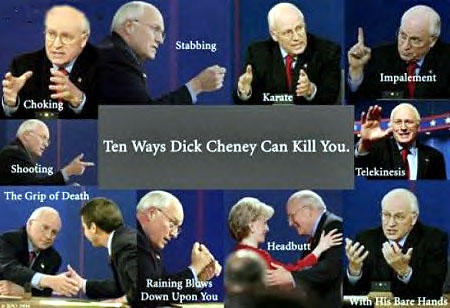
If there's one good thing that came out of Triggergate, it is this photo collage. I thank my blogging friend emaw_kc for lifting my spirits by sharing it on his blog. However, Mr. emaw_kc might be right–that the collage is in poor taste. But I don't always walk about in rarefied air. Occasionally I stoop to pick up a penny or turn my ear to a joke shared between common men. Propriety in these matters is for the tender and the persnickety. I shall laugh here, with alacrity. It is worth more than a few pennies.

A Shooting Explained In Cartoons

I have a theory, and when I have a theory I am more dangerous than Dick Cheney with a 28-gauge shotgun at sunset. Way more dangerous. But today I am going to connect some dots, dots that reach into the War on Terror, the Danish cartoons that have incited riots, and the common belief that the Bush Administration is rogue and threatening. I hope I will not strain myself as I reach from dot to dot, and I pray I will not stretch your credulity.

Let us begin with stark political facts. Over the last few weeks even the most pro-Democratic Party pundit would have a hard time defending the claim that the Democrats have had great success of late. The failure to have a meaningful showing in either rather recent US Supreme Court nomination hearings is surely baneful for Democrats; the failure to get any meaningful gain in Democrats' posturing around "domestic" wiretapping, misnamed as that is, by the Bush Administration; and failure to get any meaningful gains regarding the Party's constant complaining (like a harridan?) about the Iraq War; all these combine to make the Party look out of touch. And the recent absurdities uttered by former VP Al Gore, and the gratuitous grandstanding at the Coretta Scott King funeral by former President Jimmy Carter, portend bad days for Democrats.

Now, there are two very significant assertions made hourly by Democrats in America, and they are: America is less safe as a result of President Bush's invasions in Iraq and Afghanistan; and the Bush Administration is the most arrogant and secretive administration in history. These two ideas are repeated so often, mantra-like, they may as well be planks in the DNC platform. But there are two other assertions that have been made so often they are no longer even uttered, becoming footings in the foundations of Democratic mythology: Dick Cheney is always in hiding, and he is the de facto President of the United States.

It is easy to be fooled, but not as easy as it is to fool. Comedian, political author and pundit, Bill Maher posited for our rumination the following on Hardball with Chris Matthews on Tuesday:

Look, you know, Chris, you don‘t have to sell me on Dick Cheney being a bad guy, and just to go back to what you mentioned before, about the connection between Iraq and 9-11 -- to me, that was always a much bigger lie ... That was the bigger lie, and that's the one that Cheney kept pushing. I don't have the quotes before me, but I remember they were very carefully crafted, so the beginning of the sentence started out talking about 9-11 and the terrorists, and the end of the sentence was always, and if we could strike them at the very geographical base where they come from [ie. Iraq].

It would be easy to laugh at Maher, not because he is funny, but because he is not. Most snarky critics of the VP suggest - daily - that the VP is always in hiding, passing through America incognito. And yet they are the first to suggest that the VP sold us on the Iraq War, which would be hard to do if he's constantly in seclusion, ostensibly lying to us in absentia. But somehow Maher places the responsibility of connecting Iraq and 9/11 squarely on Cheney. Obviously Maher is not alone.

Each of us has heard the jokes and snark: Cheney, knowing what he knows now, would still shoot Harry Whittington; America has found the weapon of mass destruction--Dick Cheney; Cheney loads, aims, fires, and then ask questions later, blaming the victim. It is all typical boilerplate, inextricably linked to convictions that Cheney is arrogant, secretive, the de facto president and responsible for the War. Come to think of it, the portrait sketched of Cheney is suggestive of a cartoon character.

And cartoons do indeed play a part here. For it is my conviction that the reason many of America's most progressive newspapers refuse to print Danish cartoons critical of Islamic extremists' perversions of orthodox Islam has nothing to do with the noble protection of Islamic sentiments. It is not an effort to bring peace between warring civilizations; nor is it the praiseworthy act of placing love of one's neighbor over the love of one's right to free expression. For there is no way in hell that America's greatest defenders of speech would be so cavalier about speech.

What is going on here is subtle: the liberal establishment would like to discover anything that proves their thesis that Americans are less safe in the wake of Bush foreign policy. And it has discovered such a thing in the cartoons: America, even Europe, is so unsafe the press is even fearful of printing cartoons. Rather than things improving under Bush, things have deterioriated dramatically. Simple cartoons place us in peril! Cartoons like Dick Cheney, who created this whole war in the first place.

Triggergate is a media distraction from many things. One ignored facet of the cartoon riots is that the riots prove there is a real enemy out there; but not one provoked by American policies or actions, but by pure European values. All this media-hype steers us away from looking at what makes radical Islam radical, filled with radical hate for the West. How unfortunate. But the distraction is even more thorough, for the American press is going to worship this shooting event as a divine revelation, a miraculous vision that proves, without a doubt, everything they've tried to prove for 5 years: that "Cheney is in charge," that both President and VP are "above the law," fudging intelligence (such as fudging the details of the shooting) and manipulating the media; that both men are tyrants that shoot first and ask questions later.

That is what this is about. Politics. Not truth.

Lastly, for those who believe that the VP would have been better served to announce the shooting immediately, I offer the following:

David Gregory (in a parallel, parodied universe): Several White House officials are expressing concern tonight that Vice President Cheney's initial reaction to having shot Mr. Whittington was self-serving. Even NBC's Jay Leno got into the act, joking last night that Mr. Cheney's first reaction to the mishap was to run over to Harry Whittington and ask for his cell phone. According to Mr. Leno, Cheney called Fox News' Brit Hume and told him that he was completely responsible for the shooting.

Actually, Contratimes' witnesses of the shooting report that Cheney, after shooting at the flushed quail, rushed over to the fallen Whittington, his eyes searching left and right, up and down. My sources tell me that Whittington, aware that Cheney was in a panic, gingerly rolled over onto his side and reached behind his back. "You looking for this?" Whittington asked Cheney. The two men locked eyes, and Cheney offered a small grin. Whittington, though in pain, then flipped Cheney the bird.

[By the way, at least one Democrat suggests that Cheney intentionally delayed the report to inflate the story, knowing that the inflated story would steer the media away from problems in the White House, the War on Terror, and sundry other problems. See the seventh comment, made by David Porter, at the Democratic National Committee's Blog.]

©Bill Gnade 2006/Contratimes - All Rights Reserved.

Wednesday, February 15, 2006

Triggergate Reloaded

I know that I overdid it yesterday, but my immersion in the Dick Cheney shooting is not without intent: I want to point out how easy it is to churn out fodder for readers of any ilk. It is easy to ridicule, as easy as it is to flatter and blindly praise. Dick Cheney is no friend of mine, nor is anyone in the White House (including the press corps). But the frenzy around this story, entirely media driven (the media are ticked off!), is worth noticing with eyes wide open.

This is how distorted things are: Right now, as I type, radio talk show host Jim Braude of the Eagan & Braude show on 96.9 FM in Boston, has opined, with passion, that a local murder, where a British citizen kills his wife and daughter with one shot in their beautiful Massachusetts home, is LESS important, by far, than an accidental non-lethal hunting accident which involves the Vice President of the United States. Considering that the British citizen and young husband fled the country, returning to England; that he went through an extradition hearing (he waived extradition); that Scotland Yard was involved; that this is considered LESS important than an accident is a sorry bit of news. Add to this the national and international fascination with the "Entwistle Murders;" that Mr. Entwistle is the new Scott Peterson, and one discovers a story that is powerful, disturbing and wildly relevant: What is leading young, good-looking men of moderate success to kill their way out of their wedding vows?

Further Triggergate scandal-mongering is imminent, now that Dick Cheney is finally going to speak formally to a reporter about his misdeed. But the scandal is not that Cheney is speaking; it's that he is now speaking the wrong way. For instead of speaking to every reporter in the press pool, he is speaking (the shock!) exclusively to Fox News' Brit Hume. Shame, shame, shame.

Right now, former VP-candidate John Edwards, speaking via telephone on the Eagan & Braude show, has just said that the accident is "typical," typical of the sort of secrecy with which the Administration serves this country. (Edwards also just said that he believes that the Democrats need to assume the "moral leadership" of this country. It's all about morals, you see.)

Oiks! John Edwards, right now: "I don't believe in the same country as the country George Bush believes in."

So, this is the lesson: there are indeed TWO Americas, Bush's and Edwards'. Hence, I can understand why someone like Edwards takes umbrage with charges that his criticisms of a sitting, war-time President are unpatriotic, for Edwards is not criticizing America, he's criticizing that "other" country, the country that George Bush believes in. Edwards' country is the real America. It is there that his patriotism resides.

Talk about a unifier!