Last night I visited a blogger's safe pages to read a rather disconcerting essay on how she felt - at times - mistreated by certain other bloggers when she would leave comments at their sites. That this fine woman should experience this sort of thing at any blog is indeed disconcerting; but she wasn't talking about just any old blogs. She was talking about ostensibly Christian blogs. Sadly, she is not alone. There are too many cases where people are hurt by comments that are offered in the name of heaven yet surprisingly sting like hell.
I have promised here to be gentle with visitors, no matter what their worldviews. It is the very least I can do; and it is, at least to me, the very best thing I can do. Of course, I am aware that I do not receive loads of comments, though my traffic numbers are pretty good. I'd like to think this is due to my sticking to my guns regarding civility. But perhaps my vanity has things wrong, and I don't get long threads of comments -- usually -- because no one cares to disagree with me.
When I visit another site, I admit that, if I leave a comment, it is usually a rather long one. I do this for one reason, and one reason only. I believe the long comment reveals that I am not a bombthrower; it shows that I am not baiting anyone. Long comments allow me to flesh out my position, making it utterly transparent, showing that I am not hiding behind either a pseudonym or some sort of veiled (or even obvious) set of barbs. Besides, a thorough defense avoids -- or so one hopes -- the confusion too often associated with those defenses which consist of a few parries and thrusts. Plus, a longer comment (this only counts if I am engaged and I have issues with a position, usually) permits me to show that I take my interlocutors seriously. Respect listens, but also respect offers thoughtful replies. I realize that this sort of courtesy requires more time (or even skill) than some folks have: I can type pretty fast and words come rather easily.
Mean-spirited comments are not, of course, confined to Christian blogs (and not all Christian blogs are remotely impolite). One can find mean-spirited comments everywhere. Some essayist might write about the jerkness of jerks and then, in the blink of an eye in the comments thread, unwittingly prove himself to be one such jerk. Some hate-monger shall damn hate-mongering; some egomaniac shall berate conceit with all due haughtiness. It is a sad world, often, that one finds in comment threads; and while I am not so squeamish to recoil from those who are abusive, I nonetheless wish I could find that everyone aimed for civility. But to all this I make this free confession: there are many people who think me abusive and uncivil. Perhaps I am. But I surely try not to be either. I may be tough; I may even be stubborn. But I certainly try to be as gentle as a dove.
SOME ADVICE (to myself)
When traveling out onto the blogosphere, keep several things in mind. First, know that there are many people lying in wait to pounce, to damn, to scoff and mock and ridicule. There are countless people who are indeed mean. But there are others who are thoroughly decent.
Second, there are countless people who do not understand what an argument is, or what one even looks like; and the vast majority of folks do not have a clue about the informal fallacies. You will see mere assertions, strung together with no evidence, passed off as decisive analysis or irrefutable arguments, when they are neither. (To some folks, arguing with logic and evidence suggests that they do not have the mastery over the topic they want readers to think they have: they know things with such obvious clarity that they need not stoop to explain what should be just so obvious. But this is only a great veil over insecurity and doubt.) Plus, you will meet many people on the web who are lousy readers: they will see in your words something you never even penned, or even dreamed of penning. Not paying attention to what one reads is merely a different form of the discourtesy of not listening when someone is speaking; people too often embrace conceit and think they've "heard it all before" or they "thoroughly understand" the point before actually hearing or understanding it at all.
Third, you must not take any of this personally. I know how this all feels. Trust me. But I have come to see, though imperfectly, that if I am fair to the facts and remain faithful to reason, that the attacks hurled my way are not really hurled at me. They are hurled at the facts and the logic. If my facts and logic are false and invalid, then I will concede that I have made a mistake. But if I am called a hate-monger by someone who has not understood a word I've written; if I am called a bigot by some guy who can't tell the difference between assertions and elbows, then so be it. The problem is not mine.
Lastly, never forget your sense of wonder, humor; or your gratitude for being. There is bliss all around; grace abundant is there to be received. After all, we all realize that the best way to protect onself from harm is to stay home with the ones who love us unconditionally. We need not let the spiders of the web entangle us; we need not venture out to become some meal for cyberpredators posing as intellectuals. We can always just hit the off key, and be free.
Peace, and mirth -- and all the gratitude that is joy -- to each of you.
©Bill Gnade 2006/Contratimes - All Rights Reserved.
Tuesday, October 31, 2006


Saturday, October 28, 2006
Waking Up During The Fall
It was but a glimpse, and even then it was but a glimpse of a silhouette. It was a shimmer, a sylph; a vapor of joy and mirth in the night. It came and went like a scene between buildings spotted from the window of a speeding train. It was there, and then it wasn't. And yet it remains. Indelibly.
As I traveled into town the other night, a little after 8:00, I zipped down Concord Street with little in particular on my mind. It was a typical fall night, the edge of frost scraping at the windows, at the mums in planters, at the pumpkins on lighted front steps. Leaves piled in a light breeze along the curbs; woodsmoke curled around hedges and jumped over eaves.
Suddenly, as I approached the town funeral home, its lights on inside and out, a little girl, not more than 7 years old and wearing a little dress and overcoat, leapt off the funeral parlor's front steps and skipped toward a car at the curb, its rear passenger door swung wide open to receive her. There was glee, there was merriment; there was a pure and innocent joy in her step, the angle of her arms, the bounce of her hair. It was clear she felt free, happy, even relieved: nothing could encumber her.
But then I noticed, as I moved closer and past, that coming out of the funeral home, trailing behind the little girl, was a middle-aged woman carrying a huge funeral bouquet in a vase. She was saying goodbye to somebody, she was moving slowly; there seemed to be someone else in the foyer, another woman, more flowers, a man in a suit. There was no one else, no crowd, no line; no long queue of grief flowing down the street, like I had so often seen when some prominent person had died, or some shocking tragedy struck Peterborough. And as I readied to turn round the old library, I knew I had seen the closing moments of a wake, of calling hours: there would be a funeral or graveside service tomorrow, I knew; the flowers would be brought from one place to the next.
Who had died? Was it the little girl's grandmother, her great-grandmother? Was it her papa? Or was it someone she was supposed to know, someone in a long line of family that she knew by blood but not by face or name? Perhaps it was her little brother, or her little cousin, who had died at childbirth or because of a miscarriage. I could not know.
But it was the leap and the skip, the movement alone -- that sign of life -- that I know, and shall never forget. I do not know the little girl's name, nor do I have any idea what she looks like, blacked out as she was by the porch lights behind her and the lights shining on a funeral home's sign. There was light in that darkness, no doubt. But it did not come from any bulb or any flame. It came from a little girl, leaving death behind, leaping toward the unknown, free to be, to laugh. To swing her arms.
To make my heart skip a beat or two as I turned a corner, moving on.
Peace.
©Bill Gnade 2006/Contratimes -- All Rights Reserved.
As I traveled into town the other night, a little after 8:00, I zipped down Concord Street with little in particular on my mind. It was a typical fall night, the edge of frost scraping at the windows, at the mums in planters, at the pumpkins on lighted front steps. Leaves piled in a light breeze along the curbs; woodsmoke curled around hedges and jumped over eaves.
Suddenly, as I approached the town funeral home, its lights on inside and out, a little girl, not more than 7 years old and wearing a little dress and overcoat, leapt off the funeral parlor's front steps and skipped toward a car at the curb, its rear passenger door swung wide open to receive her. There was glee, there was merriment; there was a pure and innocent joy in her step, the angle of her arms, the bounce of her hair. It was clear she felt free, happy, even relieved: nothing could encumber her.
But then I noticed, as I moved closer and past, that coming out of the funeral home, trailing behind the little girl, was a middle-aged woman carrying a huge funeral bouquet in a vase. She was saying goodbye to somebody, she was moving slowly; there seemed to be someone else in the foyer, another woman, more flowers, a man in a suit. There was no one else, no crowd, no line; no long queue of grief flowing down the street, like I had so often seen when some prominent person had died, or some shocking tragedy struck Peterborough. And as I readied to turn round the old library, I knew I had seen the closing moments of a wake, of calling hours: there would be a funeral or graveside service tomorrow, I knew; the flowers would be brought from one place to the next.
Who had died? Was it the little girl's grandmother, her great-grandmother? Was it her papa? Or was it someone she was supposed to know, someone in a long line of family that she knew by blood but not by face or name? Perhaps it was her little brother, or her little cousin, who had died at childbirth or because of a miscarriage. I could not know.
But it was the leap and the skip, the movement alone -- that sign of life -- that I know, and shall never forget. I do not know the little girl's name, nor do I have any idea what she looks like, blacked out as she was by the porch lights behind her and the lights shining on a funeral home's sign. There was light in that darkness, no doubt. But it did not come from any bulb or any flame. It came from a little girl, leaving death behind, leaping toward the unknown, free to be, to laugh. To swing her arms.
To make my heart skip a beat or two as I turned a corner, moving on.
Peace.
©Bill Gnade 2006/Contratimes -- All Rights Reserved.
Friday, October 27, 2006
Racist Ads? Where Racism Lies
It is a controversial time. It is a pathetic time. Rarely is it ever a fun time, or even a funny time. It is nearly always a petty time, a mean one, full of vitriol and sarcasm and lies. I am talking about election time, particularly that time when political commercials bombard us.
But once in a while, there is a great, lighthearted, even silly political ad. This new Rick Santorum ad comes to mind; it sets a new standard for good-hearted fun.
Of course, there is a fully satirical, even self-mocking ad that has caused predictable controversy. It is this one by the Republican National Committee regarding Harold Ford Jr.'s bid for a Tennessee US Senate seat. I hope you have seen it; I hope you watch it. It is really quite good-natured. (Please watch it before proceeding.)
WELL?
Did you watch it? Did you think it offensive? racist?
Let's look at who this ad pokes fun at (besides Mr. Ford). Surely it pokes fun at gun-wielding hunters, white guys with weapons selling their souls to the NRA. Surely it pokes fun at Canada, and alleged middle-American values regarding that allegedly lazy socialist neighbor to the north. Surely it pokes fun at sex appeal, the face value, so to speak, of a candidate. Surely it pokes fun at retired white men, retired white conservative men. Surely, if nothing else, it pokes fun at blondes, Playboy blondes.
But do you think it pokes fun at black men? Hmm.
Here's a news story about the whole affair, and it is steeped in claims that the commercial is racist. That bastion of racial clarity, that race-free zone known as the NAACP, is quite up in arms about a certain insinuation:
"It is a powerful innuendo that plays to pre-existing prejudices about African-American men and white women," Hilary Shelton, head of the Washington NAACP office, told the Los Angeles Times.
Really? What innuendo is that? That whites can be involved sexually with blacks? Is that an innuendo? What about the black woman at the beginning of the ad, does she feed some sort of gross racial innuendo too?
(For more eye-opening video, watch as MSNBC's Chris Matthews sets us all straight about moral and racial decency. Just note that it is Matthews who believes that white males have a hard time with Harold Ford. Talk about racial innuendo. And take a moment to read some of the comments at the Huffington Post.)
What I am really curious about has everything to do with miscegenation, you know, that grotesque thing known as INTERMARRIAGE and INTERRACIAL dating, which are so often damned by racists. You know, the stuff liberals accused (for example) the Republican bastion Bob Jones University of restricting, where people of differing races cannot date. You know, that gross stereotype about mixing races. Yeah, you know, that racist stuff that meant that dumb blondes, or even smart ones, must never date black men.
Sadly, in our duly enlightened times, it is unseemly, for sure, for a black man to flirt with a white woman, or vice versa, at least to the NAACP. Egads, let us stop our ears at the thought that a white woman might find a black man SEXY, even cute (or vice versa)!
Chalk this all up to the new puritanism I've written about before, where Democrats and progressives wag their fingers at fun and very real -- and totally OK -- things. Chalk this also up to Democrats -- who just love the parodies performed by their most comedic representatives throughout the media -- having lost their sense of humor and perspective when conservatives try (!) to be funny.
There is nothing racist about the ad at all. What IS racist is the suggestion that it is.
The only thing that we should be asking is whether the ad is fair, and whether it is at all stating anything true. I am not sure it is UN-fair, though I am not sure about its truth. It seems to be an effective parody of reality: it is based on true things, but it is not direct expressions of anything actual. In some ways the piece is rather brilliant. But it is not in itself true: these are not the real thoughts of real people (at least I don't think they are). It is a satire, a spoof, of Mr. Ford's political decisions and opinions. It is, again, about making impressions, not least of which is that Republicans can lampoon with the best of them.
Lastly, it is worth noting that Democrats are crying foul about their dear Mr. Ford's sacred racial standing. That's fine with me: his race should be honored and protected. But I wonder if they would be as defensive of him if they were aware of this statement on his own website:
"I will continue to be pro-family, including supporting a constitutional amendment defining marriage as a union between a man and a woman, without taking away the civil rights of gays and lesbians."
Or this from the same essay:
"I believe that my faith mirrors the principles on which our nation was founded: equality, dignity, tolerance and freedom. These ideas formed the bedrock on which the founding fathers based their claim to independence, and these are the same lessons that Jesus preaches in the Gospel. The separation of church and state is not an order for lawmakers to ignore their faith or to banish their values. Instead, it is a command for tolerance, to recognize that not all of us share the same beliefs or worship the same god and to respect those differences.
"And so, I will continue to be guided by my faith in the Senate. …"
Is he not really a guy who wants to impose his religious beliefs on public policy? Is he NOT a homophobe?
It's all just so interesting!
Peace.
©Bill Gnade 2006/Contratimes - All Rights Reserved.
Technorati tags: Harold Ford Jr., Playboy, Political Advertising, Political Commercials, Chris Matthews, Racism
But once in a while, there is a great, lighthearted, even silly political ad. This new Rick Santorum ad comes to mind; it sets a new standard for good-hearted fun.
Of course, there is a fully satirical, even self-mocking ad that has caused predictable controversy. It is this one by the Republican National Committee regarding Harold Ford Jr.'s bid for a Tennessee US Senate seat. I hope you have seen it; I hope you watch it. It is really quite good-natured. (Please watch it before proceeding.)
WELL?
Did you watch it? Did you think it offensive? racist?
Let's look at who this ad pokes fun at (besides Mr. Ford). Surely it pokes fun at gun-wielding hunters, white guys with weapons selling their souls to the NRA. Surely it pokes fun at Canada, and alleged middle-American values regarding that allegedly lazy socialist neighbor to the north. Surely it pokes fun at sex appeal, the face value, so to speak, of a candidate. Surely it pokes fun at retired white men, retired white conservative men. Surely, if nothing else, it pokes fun at blondes, Playboy blondes.
But do you think it pokes fun at black men? Hmm.
Here's a news story about the whole affair, and it is steeped in claims that the commercial is racist. That bastion of racial clarity, that race-free zone known as the NAACP, is quite up in arms about a certain insinuation:
"It is a powerful innuendo that plays to pre-existing prejudices about African-American men and white women," Hilary Shelton, head of the Washington NAACP office, told the Los Angeles Times.
Really? What innuendo is that? That whites can be involved sexually with blacks? Is that an innuendo? What about the black woman at the beginning of the ad, does she feed some sort of gross racial innuendo too?
(For more eye-opening video, watch as MSNBC's Chris Matthews sets us all straight about moral and racial decency. Just note that it is Matthews who believes that white males have a hard time with Harold Ford. Talk about racial innuendo. And take a moment to read some of the comments at the Huffington Post.)
What I am really curious about has everything to do with miscegenation, you know, that grotesque thing known as INTERMARRIAGE and INTERRACIAL dating, which are so often damned by racists. You know, the stuff liberals accused (for example) the Republican bastion Bob Jones University of restricting, where people of differing races cannot date. You know, that gross stereotype about mixing races. Yeah, you know, that racist stuff that meant that dumb blondes, or even smart ones, must never date black men.
Sadly, in our duly enlightened times, it is unseemly, for sure, for a black man to flirt with a white woman, or vice versa, at least to the NAACP. Egads, let us stop our ears at the thought that a white woman might find a black man SEXY, even cute (or vice versa)!
Chalk this all up to the new puritanism I've written about before, where Democrats and progressives wag their fingers at fun and very real -- and totally OK -- things. Chalk this also up to Democrats -- who just love the parodies performed by their most comedic representatives throughout the media -- having lost their sense of humor and perspective when conservatives try (!) to be funny.
There is nothing racist about the ad at all. What IS racist is the suggestion that it is.
The only thing that we should be asking is whether the ad is fair, and whether it is at all stating anything true. I am not sure it is UN-fair, though I am not sure about its truth. It seems to be an effective parody of reality: it is based on true things, but it is not direct expressions of anything actual. In some ways the piece is rather brilliant. But it is not in itself true: these are not the real thoughts of real people (at least I don't think they are). It is a satire, a spoof, of Mr. Ford's political decisions and opinions. It is, again, about making impressions, not least of which is that Republicans can lampoon with the best of them.
Lastly, it is worth noting that Democrats are crying foul about their dear Mr. Ford's sacred racial standing. That's fine with me: his race should be honored and protected. But I wonder if they would be as defensive of him if they were aware of this statement on his own website:
"I will continue to be pro-family, including supporting a constitutional amendment defining marriage as a union between a man and a woman, without taking away the civil rights of gays and lesbians."
Or this from the same essay:
"I believe that my faith mirrors the principles on which our nation was founded: equality, dignity, tolerance and freedom. These ideas formed the bedrock on which the founding fathers based their claim to independence, and these are the same lessons that Jesus preaches in the Gospel. The separation of church and state is not an order for lawmakers to ignore their faith or to banish their values. Instead, it is a command for tolerance, to recognize that not all of us share the same beliefs or worship the same god and to respect those differences.
"And so, I will continue to be guided by my faith in the Senate. …"
Is he not really a guy who wants to impose his religious beliefs on public policy? Is he NOT a homophobe?
It's all just so interesting!
Peace.
©Bill Gnade 2006/Contratimes - All Rights Reserved.
Technorati tags: Harold Ford Jr., Playboy, Political Advertising, Political Commercials, Chris Matthews, Racism
The Blind, Pulling The Wool
There's a headline in today's New York Times, and I want to tell you why it is disturbing. The headline reads:
G.O.P. Moves Fast to Reignite Issue of Gay Marriage
The headline comes in the wake of the New Jersey Supreme Court's decision on Wednesday that gays and lesbians are entitled to equal rights under New Jersey law. In reporting on that decision, The New York Times headline read "New Jersey Court Backs Full Rights for Gay Couples."
Please, note the difference in headlines. Pay particular attention to the first headline. For it argues that Republicans have reignited something that had long since burned out. To the editors at the NYT, Republicans have reignited a flame long ago extinguished by cool-headed thinkers like those directing The Times (and they do try to direct the times, don't they?). The issue was, apparently, a done-deal, a non-issue. No one was thinking about it, burning about it; no one cared. And then, on cue, Republicans seized a simple court decision and instantly set it ablaze for political gain. Republicans are rallying the "conservative base" once again in a self-serving effort to maintain political control over basic human rights.
Of course, only a person trying to propagandize the masses would imply that the issue of gay marriage had somehow been snuffed out. The fact is, it's been burning for years, and rather quite brightly.
Note what the headline to either news item does not insinuate, namely, that a New Jersey court decision may have been handed down to mobilize Democratic operatives intent on redefining marriage. Note that neither story focuses on the fact that certain Democrats and their pet interest groups have been politically reinforced by the New Jersey court; nothing is said about how the New Jersey decision reignites anybody (though it clearly does). Also, please note, that neither headline suggests that gay-marriage-friendly Democrats will be motivated to go to the polls to support candidates and measures that will enshrine gay marriage in language that makes it equal to heterosexual marriage. The G.O.P. is trying to reignite a fire that should not be lit; it is trying to motivate its base. Of course, the Democrats are NOT trying to ignite the issue; nor are they trying to ignite a flame beneath their party's feet.
You might recall the sheer idiocy of comments surrounding gay marriage amendment initiatives in several states during the 2004 elections. You may have heard that Karl Rove, ranked as a demigod by Democrats, positioned these amendments on state ballots, using them as a clarion call to homophobes everywhere to vote Republican. But surely the idiocy, and fallaciousness, are instantly obvious: if gay marriage is a desirable thing, then amendments on ANY state ballot would motivate voters WHO ARE PRO-GAY TO TURN OUT IN DROVES. In other words, had Karl Rove in fact drummed up such a scheme, he would have known that such initiatives would have been inspiration for the apparently tens of millions of voters who love the idea of gay marriage and who would, invariably, vote as Democrats. But the fact is this, and even the headline above intimates it: voters repeatedly reject the argument that gay marriage is equal to traditional marriage. Including, believe it or not, Democrat voters.
And that is why the New Jersey court decision is so important. To hell with the will of the people. Only a few folks really have the direct line to God and legal clarity on this; they sit on courts, in academia, and the high places in American journalism. The rest of us are just plain bigots, for we do not believe that two gay men in bed are equal to a man and woman in bed or even sitting on a bus. Nor do we believe, as most African-Americans do not believe, that the issue of gay marriage is on the same plane, or even on the same bus, as civil rights issues for blacks were in the 1950s and 1960s: anti-black bigotry is not remotely the same as alleged anti-gay bigotry. Nor does anyone notice that it is a sort of reverse bigotry that assails traditional marriage proponents; that such proponents are "homophobic" and "zealous religious nuts", that they are "hyprocrites" for not berating other perversions of so-called "sacred marriage", like divorce, spousal abuse, and sundry other infidelities; that traditional marriage is "merely about love and commitment between two people". Such name-calling is indeed a type of bigotry, a type of rendering people as less than whole, or even less than human; and such reductionism gives the lie that pro-gay proponents adore the lofty ideal of marriage, for it is quite clear that the only way they can equate traditional marriage -- which has stood as a sacrament for centuries -- to gay marriage, is to reduce the beauty, import, and value of the sacrament: it is just about love, commitment, companionship. Traditional marriage proponents are not entitled, either in the opinion of the courts or The New York Times, to define themselves or marriage the way they see fit; they must define marriage (and, by extension, their own selves) some OTHER way (sort of the way blacks were not allowed to define themselves as fully human and fully American).
In the end, if any reader of The New York Times believes that the Republican Party is reigniting anything about gay marriage, such a reader deserves The New York Times. The rest of us, without reading that great grey sage, are more than duly informed.
Anyhow, just some thoughts on a slow Friday. (Friday, as some of you may know, appears to be a blogger's low day, as blog traffic seems to really take a dive. At least it does here, even rather precipitously. It is the slowest day of the week by far.)
Peace.
©Bill Gnade 2006/Contratimes - All Rights Reserved.
G.O.P. Moves Fast to Reignite Issue of Gay Marriage
The headline comes in the wake of the New Jersey Supreme Court's decision on Wednesday that gays and lesbians are entitled to equal rights under New Jersey law. In reporting on that decision, The New York Times headline read "New Jersey Court Backs Full Rights for Gay Couples."
Please, note the difference in headlines. Pay particular attention to the first headline. For it argues that Republicans have reignited something that had long since burned out. To the editors at the NYT, Republicans have reignited a flame long ago extinguished by cool-headed thinkers like those directing The Times (and they do try to direct the times, don't they?). The issue was, apparently, a done-deal, a non-issue. No one was thinking about it, burning about it; no one cared. And then, on cue, Republicans seized a simple court decision and instantly set it ablaze for political gain. Republicans are rallying the "conservative base" once again in a self-serving effort to maintain political control over basic human rights.
Of course, only a person trying to propagandize the masses would imply that the issue of gay marriage had somehow been snuffed out. The fact is, it's been burning for years, and rather quite brightly.
Note what the headline to either news item does not insinuate, namely, that a New Jersey court decision may have been handed down to mobilize Democratic operatives intent on redefining marriage. Note that neither story focuses on the fact that certain Democrats and their pet interest groups have been politically reinforced by the New Jersey court; nothing is said about how the New Jersey decision reignites anybody (though it clearly does). Also, please note, that neither headline suggests that gay-marriage-friendly Democrats will be motivated to go to the polls to support candidates and measures that will enshrine gay marriage in language that makes it equal to heterosexual marriage. The G.O.P. is trying to reignite a fire that should not be lit; it is trying to motivate its base. Of course, the Democrats are NOT trying to ignite the issue; nor are they trying to ignite a flame beneath their party's feet.
You might recall the sheer idiocy of comments surrounding gay marriage amendment initiatives in several states during the 2004 elections. You may have heard that Karl Rove, ranked as a demigod by Democrats, positioned these amendments on state ballots, using them as a clarion call to homophobes everywhere to vote Republican. But surely the idiocy, and fallaciousness, are instantly obvious: if gay marriage is a desirable thing, then amendments on ANY state ballot would motivate voters WHO ARE PRO-GAY TO TURN OUT IN DROVES. In other words, had Karl Rove in fact drummed up such a scheme, he would have known that such initiatives would have been inspiration for the apparently tens of millions of voters who love the idea of gay marriage and who would, invariably, vote as Democrats. But the fact is this, and even the headline above intimates it: voters repeatedly reject the argument that gay marriage is equal to traditional marriage. Including, believe it or not, Democrat voters.
And that is why the New Jersey court decision is so important. To hell with the will of the people. Only a few folks really have the direct line to God and legal clarity on this; they sit on courts, in academia, and the high places in American journalism. The rest of us are just plain bigots, for we do not believe that two gay men in bed are equal to a man and woman in bed or even sitting on a bus. Nor do we believe, as most African-Americans do not believe, that the issue of gay marriage is on the same plane, or even on the same bus, as civil rights issues for blacks were in the 1950s and 1960s: anti-black bigotry is not remotely the same as alleged anti-gay bigotry. Nor does anyone notice that it is a sort of reverse bigotry that assails traditional marriage proponents; that such proponents are "homophobic" and "zealous religious nuts", that they are "hyprocrites" for not berating other perversions of so-called "sacred marriage", like divorce, spousal abuse, and sundry other infidelities; that traditional marriage is "merely about love and commitment between two people". Such name-calling is indeed a type of bigotry, a type of rendering people as less than whole, or even less than human; and such reductionism gives the lie that pro-gay proponents adore the lofty ideal of marriage, for it is quite clear that the only way they can equate traditional marriage -- which has stood as a sacrament for centuries -- to gay marriage, is to reduce the beauty, import, and value of the sacrament: it is just about love, commitment, companionship. Traditional marriage proponents are not entitled, either in the opinion of the courts or The New York Times, to define themselves or marriage the way they see fit; they must define marriage (and, by extension, their own selves) some OTHER way (sort of the way blacks were not allowed to define themselves as fully human and fully American).
In the end, if any reader of The New York Times believes that the Republican Party is reigniting anything about gay marriage, such a reader deserves The New York Times. The rest of us, without reading that great grey sage, are more than duly informed.
Anyhow, just some thoughts on a slow Friday. (Friday, as some of you may know, appears to be a blogger's low day, as blog traffic seems to really take a dive. At least it does here, even rather precipitously. It is the slowest day of the week by far.)
Peace.
©Bill Gnade 2006/Contratimes - All Rights Reserved.
Thursday, October 26, 2006
"But Most Importantly, Our Sons"
 He is 36 years old. He still lives at home with his parents. He lives near a ravine, Huntington Gorge. And he has had something of a sick fantasy. At least, that is my guess.
The sick fantasy is to snatch a woman, beat, rape and murder her; and then, after putting her pants back on her body, the fantasy is to wedge her between rocks at the bottom of the nearby gorge, cover her with some debris, and go home to bed. Everyone, perhaps, will think that the victim fell in the dark, perhaps too drunk to know where she was, lost in an alcohol haze having taken a ride in some taxi who-knows-where†.
The fantasy became reality for Brian L. Rooney on October 7, between the hours of 2:00 and 4:30 in the morning. And the sick, twisted fantasy became a nightmare for 21-year-old Michelle Gardner-Quinn, a University of Vermont student hailing from Arlington, VA. Her parents, who were visiting UVM for Parents' Weekend and who were with their daughter the night she disappeared while she walked down Burlington's most public street, made tearful pleas for Michelle's safe return, but to no avail. Police later found the man who assisted Michelle when her cell phone's batteries died; he had loaned her his phone as she chatted with friends, trying to hook up with them several blocks away on the same street; the man would hear that she was fully alone, and the door was open. No doubt it was kindness, capricious to the core, that he used to entrap Michelle. A store surveillance camera would capture him walking with Michelle along the sidewalk; there seems to be no tension between them. But darkness often appears as light; evil is often hidden behind goodness. A predator had his prey, and a young woman had no idea.


Hikers, six days later, would find her in a lonely ravine.
THIS IS WHAT WE NEED TO HEAR
I need not over-explain the following quote. Just know that I believe it is one of the most important statements to be uttered in a long time; the context makes it nearly over-powering. I have strained on this blog to get close to the lesson that follows, but I have merely groped in the dark towards the heart of the issue. What follows, really, IS the heart. Let me simply let you read the quote by Burlington, VT police chief Thomas R. Tremblay when he spoke at a press conference Wednesday afternoon:
"Being aware that crime can occur, anywhere, to anyone, is the first step in crime prevention. However, we cannot let these terrible crimes paralyze us in fear. We must demand our freedom from violence and crime. We must also renew our commitment to ending violence against women, violence perpetrated by men – in the form of domestic and sexual violence.
"As a community we must move beyond "victim blaming" and direct more efforts at those who are responsible for the violence. As a society we must do more to educate boys and men to stop acts of violence against women. We should talk with our friends, our families, our children – certainly our daughters, but most importantly our sons … "[emphasis added]
Our sons, indeed. We might want to pray for them as well.
Peace, at least for one day. And may mercy, peace and comfort fall on the family of Michelle Gardner-Quinn, and even on Michelle herself. Oh, how we pray there is more to life than this.
†I want it to be understood that I am not suggesting that Ms. Gardner-Quinn was drunk, or that she deserves any of this, or anything of the sort.
©Bill Gnade 2006/Contratimes - All Rights Reserved.
[Photograph of Burlington Police Chief Thomas R. Tremblay with portrait of Michelle Gardner-Quinn taken yesterday, as Chief Tremblay made his statement quoted above. Photo by Toby Talbot, AP. Image, and story, can be found here.]
Technorati tags: Michelle Gardner-Quinn, UVM, Violence against women
Black And Red? Hah! He Cannot Shine
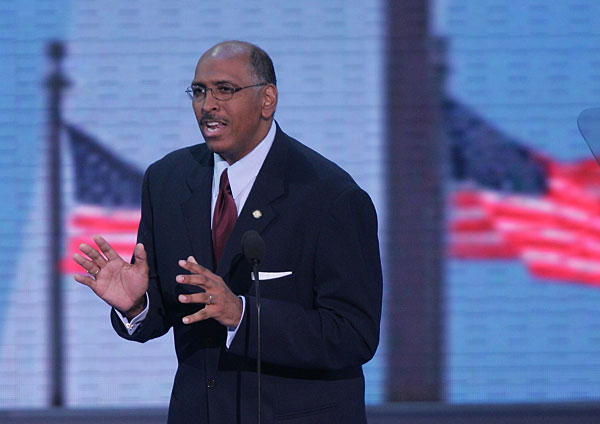 I spoke two days ago about one of the great rising stars of the Democrat party, Sen. Barack Hussein Obama, Jr. I did so because he is in fact a rising star, and he is being very much courted by the media: some have already suggested that he is the man who will deliver the country in 2008, procuring the White House and leading America forward in an audacious pursuit of hope.
But I must ask how many Contratimes readers have ever heard of the first African-American man to be elected to state-wide office in Maryland. Perhaps only a few of you know the name of that man; I know that I forgot about him until yesterday. The man is Michael Steele (pictured above); a handsome, bright, and articulate man who has served Maryland as Lt. Governor and is currently campaigning for a US Senate seat against Democratic congressman Ben Cardin. Apparently it is a very spirited battle.
I am going to make a wild proclamation. I am going to suggest that Michael Steele, every bit as bright and interesting and handsome and capable as Barack Obama, is not a rising star for one simple reason: He's a Republican.
But I will refrain from speaking further on this for the time being. There is one man, an African-American man, who has written a blistering commentary on the treatment of Mr. Steele by the Democrats around him. It is a worthy read. But I warn you. It is fiery and fierce. I am under the distinct impression that beneath all that fire, the author is probably quite right. Which means that this is all very, very sad.
©Bill Gnade 2006/Contratimes - All Rights Reserved.
Technorati tags: Michael Steele, Barack Obama
Wednesday, October 25, 2006
Speaking Before Thinking: Rush To Judgment
It is not the sort of thing I'd brag about. It is the sort of thing that happens solely by chance. I am talking about listening to conservative political pundit Rush Limbaugh on the radio, or watching him on TV. This is not the kind of activity I've ever planned; it is not something I've ever looked forward to. But I must say that I can remember two times, and two times only, that I've listened to Rush Limbaugh, and the reason I remember these times is that Limbaugh made me cringe. I am not saying I haven't listened to him more than twice; I have, perhaps ten times in total. It's just that I remember two times in particular.
The first time I was home with a cast on my ankle; it was a Sunday, and ESPN was airing its NFL Sunday pregame TV show. There, Mr. Limbaugh, the "color" commentator sitting all by himself, away from the other analysts (so far away, in fact, that he seemed to be quarantined), made the rather unfortunate claim that the Philadelphia Eagles' quarterback, Donovan McNabb, was not an outstanding player, but was merely propped up by the media who wanted to see a black quarterback succeed, or something to that effect. I was alarmed by the commentary, though I was surprised that in a country enamored of free speech, Mr. Limbaugh would be fired the next day from his brief stint as a football analyst. Limbaugh was no doubt wrong: Donovan McNabb continues to shine as one of the great quarterbacks in the NFL. But I can tolerate a dopey opinion every now and then, and I did not think Mr. Limbaugh's remarks were overtly racist. They were just plain dumb. Commentators are not usually fired for being dumb, are they? (For the comments of a sports columnist, and Eagles' fan, who agreed with Mr. Limbaugh, check out this essay at Slate.)
And then, this past Monday afternoon, as I was pulling into the bank to make a quick deposit, I landed on Limbaugh's radio talkshow. And there, as I sat in bank parking lot, he made another startling statement which I could not believe I was hearing. The topic, as you no doubt know by now, was Michael J. Fox's political commercial regarding stem-cell research to combat, among other things, Parkinson's disease, a disease from which Mr. Fox suffers. Here is part of what Mr. Limbaugh said:
"He is exaggerating the effects of the disease ... He's moving all around and shaking and it's purely an act. . . . This is really shameless of Michael J. Fox. Either he didn't take his medication or he's acting."
OK. I love Michael J. Fox, which is to be expected, since we are the same age and I grew up watching him mature into a great comedic actor. He lives in Vermont, which makes me feel like he's a neighbor. His disease is grotesque and sad, as are all diseases, really; but it struck me hard when I learned of Mr. Fox's struggle, and it continues to strike me hard. No doubt it would not strike me as hard as it would if Mr. Fox was my brother or my son, or if Parkinson's struck me.
I predicted, and I was right, that Mr. Limbaugh would be excoriated by the press for his over-certain remarks. EVEN though I heard Mr. Limbaugh apologize, repeatedly, for his remarks only moments after he made them, when staffers and callers corrected him; even though I heard Mr. Limbaugh the next day (I did plan to tune in Tuesday) correct himself -- repeatedly -- for his remarks, I knew he would be raked over the coals for his recklessness. And he should be, perhaps, even if he has nearly instantly retracted them. One glaringly sad fact is that Mr. Limbaugh's critics are focusing on the mistake rather than the apology, as if the whole of Mr. Limbaugh's comments don't matter. But they do matter, very much; people say wrong things all the time, and we forgive them when they recognize their fallibility and their foolishness. But not if you're Mr. Limbaugh. But if his mistake makes him a sinner, how do his profuse apologies not make him a saint?
I cannot know Mr. Fox's motives for appearing in campaign commercials in which he asserts that his candidate's opponent wants to "criminalize the science" that MIGHT lead to cures for such things as Parkinson's. My penchant is for asking whether what Mr. Fox has said is true. But, like most political language, it is indeed true: someone may indeed want to criminalize medical procedures that are immoral but MIGHT have a positive effect elsewhere. But they MIGHT NOT have a good effect at all, and Mr. Fox's language leaves us with nothing but political talking points: we have nothing to really trust. He might be telling the truth, and he might not. Winning is what matters, creating an impression is what counts. Moreover, I can sympathize with Mr. Fox's many losses, and I do; but I cannot sympathize when he enters the political arena and is duly challenged. His sickness does not entitle him to be above reproach; his illness does not safeguard him from being challenged, especially if he tosses veiled accusations that some Republicans actually want to keep people like him addled by disease. For that -- is it not? -- is the suggestion: vote for candidate X or else candidate Y will let the sick stay sick. Is that not also offensive? Is that not also a slander? Well, if it isn't, it should be.
But we are talking politics, which is all about speaking certain lines on cue, posing for cameras, creating impressions and, along the way, even a few sensations.
Peace to Michael J. Fox today, and all those who suffer from debilitating diseases.
[Update: MSNBC, right now (at 12:12 EST), is discussing the Limbaugh statements. Oddly, MSNBC reports that Limbaugh did indeed utter a foolish thing; but the network is also reporting that Rush "later apologized." The implication is that "later" was after Limbaugh was confronted publicly. In fact, Limbaugh apologized nearly INSTANTLY, and he retracted his words. If "later" means subsequent, then MSNBC is right. But they want to mislead its listeners. Moreover, Limbaugh even retracted his words: a retraction is an admission that the words are not valid; that, in reality, they do not exist as Limbaugh's words. What this is all about, ultimately, is stirring up the suspicion that Republicans are heartless, cold, cruel, and could care less about suffering. It is not about Parkinson's, suffering, or scientific research. It is about despoiling character, winning votes, and controlling taxpayer money.]
©Bill Gnade 2006/Contratimes - All Rights Reserved.
Technorati tags: Rush Limbaugh, Michael J. Fox
The first time I was home with a cast on my ankle; it was a Sunday, and ESPN was airing its NFL Sunday pregame TV show. There, Mr. Limbaugh, the "color" commentator sitting all by himself, away from the other analysts (so far away, in fact, that he seemed to be quarantined), made the rather unfortunate claim that the Philadelphia Eagles' quarterback, Donovan McNabb, was not an outstanding player, but was merely propped up by the media who wanted to see a black quarterback succeed, or something to that effect. I was alarmed by the commentary, though I was surprised that in a country enamored of free speech, Mr. Limbaugh would be fired the next day from his brief stint as a football analyst. Limbaugh was no doubt wrong: Donovan McNabb continues to shine as one of the great quarterbacks in the NFL. But I can tolerate a dopey opinion every now and then, and I did not think Mr. Limbaugh's remarks were overtly racist. They were just plain dumb. Commentators are not usually fired for being dumb, are they? (For the comments of a sports columnist, and Eagles' fan, who agreed with Mr. Limbaugh, check out this essay at Slate.)
And then, this past Monday afternoon, as I was pulling into the bank to make a quick deposit, I landed on Limbaugh's radio talkshow. And there, as I sat in bank parking lot, he made another startling statement which I could not believe I was hearing. The topic, as you no doubt know by now, was Michael J. Fox's political commercial regarding stem-cell research to combat, among other things, Parkinson's disease, a disease from which Mr. Fox suffers. Here is part of what Mr. Limbaugh said:
"He is exaggerating the effects of the disease ... He's moving all around and shaking and it's purely an act. . . . This is really shameless of Michael J. Fox. Either he didn't take his medication or he's acting."
OK. I love Michael J. Fox, which is to be expected, since we are the same age and I grew up watching him mature into a great comedic actor. He lives in Vermont, which makes me feel like he's a neighbor. His disease is grotesque and sad, as are all diseases, really; but it struck me hard when I learned of Mr. Fox's struggle, and it continues to strike me hard. No doubt it would not strike me as hard as it would if Mr. Fox was my brother or my son, or if Parkinson's struck me.
I predicted, and I was right, that Mr. Limbaugh would be excoriated by the press for his over-certain remarks. EVEN though I heard Mr. Limbaugh apologize, repeatedly, for his remarks only moments after he made them, when staffers and callers corrected him; even though I heard Mr. Limbaugh the next day (I did plan to tune in Tuesday) correct himself -- repeatedly -- for his remarks, I knew he would be raked over the coals for his recklessness. And he should be, perhaps, even if he has nearly instantly retracted them. One glaringly sad fact is that Mr. Limbaugh's critics are focusing on the mistake rather than the apology, as if the whole of Mr. Limbaugh's comments don't matter. But they do matter, very much; people say wrong things all the time, and we forgive them when they recognize their fallibility and their foolishness. But not if you're Mr. Limbaugh. But if his mistake makes him a sinner, how do his profuse apologies not make him a saint?
I cannot know Mr. Fox's motives for appearing in campaign commercials in which he asserts that his candidate's opponent wants to "criminalize the science" that MIGHT lead to cures for such things as Parkinson's. My penchant is for asking whether what Mr. Fox has said is true. But, like most political language, it is indeed true: someone may indeed want to criminalize medical procedures that are immoral but MIGHT have a positive effect elsewhere. But they MIGHT NOT have a good effect at all, and Mr. Fox's language leaves us with nothing but political talking points: we have nothing to really trust. He might be telling the truth, and he might not. Winning is what matters, creating an impression is what counts. Moreover, I can sympathize with Mr. Fox's many losses, and I do; but I cannot sympathize when he enters the political arena and is duly challenged. His sickness does not entitle him to be above reproach; his illness does not safeguard him from being challenged, especially if he tosses veiled accusations that some Republicans actually want to keep people like him addled by disease. For that -- is it not? -- is the suggestion: vote for candidate X or else candidate Y will let the sick stay sick. Is that not also offensive? Is that not also a slander? Well, if it isn't, it should be.
But we are talking politics, which is all about speaking certain lines on cue, posing for cameras, creating impressions and, along the way, even a few sensations.
Peace to Michael J. Fox today, and all those who suffer from debilitating diseases.
[Update: MSNBC, right now (at 12:12 EST), is discussing the Limbaugh statements. Oddly, MSNBC reports that Limbaugh did indeed utter a foolish thing; but the network is also reporting that Rush "later apologized." The implication is that "later" was after Limbaugh was confronted publicly. In fact, Limbaugh apologized nearly INSTANTLY, and he retracted his words. If "later" means subsequent, then MSNBC is right. But they want to mislead its listeners. Moreover, Limbaugh even retracted his words: a retraction is an admission that the words are not valid; that, in reality, they do not exist as Limbaugh's words. What this is all about, ultimately, is stirring up the suspicion that Republicans are heartless, cold, cruel, and could care less about suffering. It is not about Parkinson's, suffering, or scientific research. It is about despoiling character, winning votes, and controlling taxpayer money.]
©Bill Gnade 2006/Contratimes - All Rights Reserved.
Technorati tags: Rush Limbaugh, Michael J. Fox
Tuesday, October 24, 2006
A New Magnificat
 In Swahili his name means "one who is blessed." It seems a fitting name. In fact, in American politics his name surely means "charmed."
Of course, I am talking about the freshman senator from Illinois, Barack Hussein Obama, Jr. He is being presented to us as the next big thing; he is the rising star in American progressivism. He graces the cover of the most recent Time magazine; he streaked across the talkshow skies this past weekend, and we are left with a glowing after-image seared into our minds.

Some of you might recall that the late Pope John Paul II wrote a book called Crossing The Threshold of Hope, which was wildly popular among the faithful. It still ranks in the top 20,000 of Amazon. Now comes The Audacity of Hope, written by Mr. Obama, which ranks atop both today's Amazon and Barnes & Noble bestseller lists. It has not yet this morning shown up on the New York Times bestseller list, but we need but wait another thirty seconds and it will be perched on top, I am sure.
I watched Mr. Obama on NBC's Meet the Press with Tim Russert, (transcript is here) and I must say he is, indeed, a winner. I have no doubt that he shall be a very serious candidate for president, particularly in 2012. However, my sense is that he is, perhaps, still too young to make it to the White House two years from now. After all, he has yet to have to fight in even one reelection campaign. And I think he might be bucking history, though I am not sure; for if he does aim for the White House in 2008, he might very well be the first senator to win the presidency before completing one whole term in the Senate.
HOSANNA POLITICS
Remember with me what it was like, at least according to the gospels, when Jesus entered Jerusalem just days before his crucifixion. He was greeted with fanfare, palm branches laid out before him, his supporters shouting "Hosanna!" as he passed (Hosanna! means "save!" or "save us!" It is a cry of worship and praise, but one mixed with a plea for deliverance.) As Jesus entered Jerusalem, people greeted him as deliverer and savior.
I am struck every election cycle (at least since I have been paying attention) how often this sort of imagery and language is employed. Candidates come as deliverers: all will be right if we just elect so-and-so. It is rather alarming, for it would seem Americans (in particular) would be wary of this sort of idolatry. No one can save us, though a man or woman can surely assist us. But we must face the very real fact that we will never be delivered from an imperfect state, nor will we ever reach one that is more just. Justice is an elusive idea, as it is so often shaped by the smallest minority incensed that its particularly unique qualities are not held in higher esteem or respect. Such injustices can be found on nearly every street corner; shouts of "unfair!" do not stop in the wake of better laws or better leaders. This is not to say that there are not injustices that have been made right. It is merely to say that there will never be any rest from the fight for a more just world. In all of this, no man or woman can step in as our deliverer or liberator. They can only help us, but not as clairvoyant or prescient guides. They can help us by being willing to fight for what is hopefully right, and hopefully good.
Unfortunately we cannot remove from our political life images smacking of messianism. Jesus comes as representative of heaven; not only that, he comes as our representative to heaven. He stands in our stead; he dies as our substitute on the cross. In Christianity, it seems, there is no salvation - or damnation - without representation. Christ is the law and our public defender; he is the advocate on our behalf, doing for us what we cannot do or have no time to do. He intercedes for us; he mediates, and he takes our place when the guilty verdict is handed down. He is taken away in shackles, while we are free to go.
Curiously, political representation comprises this same sort of imagery. If there is no expectation in heaven without representation, there is no taxation without representation here in America. Senators and representatives and presidents stand before the ideals of the American state on our behalf. They are our mediators, defenders and advocates. They will do for us what we cannot do for ourselves. Before the great courts of men in Washington, our elected officials stand as us incarnate. And they do so before that great Trinity, that great Godhead of the executive, legislative and judicial branches.
No wonder it is so tempting to speak of candidates in implicitly religious terms, that they shall "save us" from domestic and foreign enemies. No wonder some leaders might present themselves even in messianic terms. So many of us expect so much from our leaders. I even think that we often expect too much of ourselves, living vicariously through the man or woman for whom we voted, certain that we, along with them, know how to save the world.
THE AUDACITY OF HOPE
It is a catchy title, full of poetry and boldness. There is even a veiled criticism hidden therein, that here is a man daring to hope in the face of naysayers; here is a man willing to rally the despondent masses to reject the pessismism of our current leaders, and our current paradigm. And there is even a religious simplicity to it, begging us to remember St. Paul: "Now these three remain, faith, hope and love." Hope audacious? Only to the liberty deniers among us.
Of course, I have yet to read Mr. Obama's book. I am sure that when I do read it, he will help me answer the question: Hope in what? Or are we merely to hope in hope? I hope not. And I am not quite ready to go as far as Boston radio talk show host Jay Severin went yesterday on air, whispering on in hushed, reverent tones about the left's new saint, "Saint Obama." But sainthood is in the air.
Really, it is.
ONE LAST NOTE ON "BLESSED"
I visited Daily Kos, the world's largest blog, this morning. I was searching for items on Mr. Obama, and I was surprised to find that Mr. Obama has himself posted something at Daily Kos. But I want you to note an advertising banner over Mr. Obama's essay. It is an adlink for MSNBC's news team. But note two things. Note that you find, right in the middle, a picture of the leftists' new favorite pundit, Keith Olbermann. Then, one image over, note that there is a picture of Mr. Obama, facing right, adjacent to a picture of President Bush, who is looking left. This is no accident at all. MSNBC might as well say that it is pitching Mr. Obama for President right now.

The second thing I want you to note is that MSNBC is advertising on the most liberal blog on the planet. It would be foolish to think that FoxNews would be a featured advertiser there; and it would be foolish not to think that, if Fox is indeed a mouthpiece of the Bush White House, MSNBC is aligning itself as a mouthpiece for all things progressive. After all, that is what Mr. Obama is after, since he aims to create a "workable progressive majority in this country."
This all, really, should be quite interesting.
Peace.
©Bill Gnade 2006/Contratimes - All Rights Reserved.
[Barack Obama photograph originally found here. Image by Reuters.]

Technorati tags: Barack Obama, Hosanna politics
Monday, October 23, 2006
Moron, I Mean, More On Reconstruction
As some of you have noticed, I've been adding photographs to the right column of this site. I do not know whether such "art" makes the page more or less appealing. I will figure things out as I go, I am sure. But for now I am trying to beautify what has been rather bland, and I am doing so within what I have thus far mastered of the new Blogger formats. If I could, I would build a much better looking site, but I can't. This will have to do.
Thanks for your patience as I move things here, there, and just about everywhere.
Gnade
Thanks for your patience as I move things here, there, and just about everywhere.
Gnade
Friday, October 20, 2006
When Michael Helps Michael
 His name was Michael Briggs, and he was 35 years old. I did not know him, but I wish I had. He was a good father of two boys; he loved his wife, Laura. And he loved to help people. In fact, he was awarded the highest honors for helping rescue normal folk -- as normal as you and me -- from a burning apartment building in the early morning hours in July 2004.
Michael was a police officer in Manchester, NH. He worked on what was dubbed the "Jeep Patrol," that late-night shift where cops tour neighborhoods on mountain bikes. He loved his job, his colleagues, and the neighborhoods he watched so carefully. Today, and tomorrow, and for days to come, those neighborhoods and colleagues will gather together in small clutches of grief -- candles and cards and flowers in shaking hands -- and they shall find solace in memory, and inspiration in courage.
Michael Briggs probably did not know that the man he was approaching at 2:45 in the morning was familiar to him, even intimately familiar. Nor could the man he was approaching, Michael "Stix" Addison, 26, know that the cop who came toward him was someone who had helped him in a moment of pain and panic; Officer Briggs had responded to a shooting at an apartment in March 2003 and, as the first officer on the scene, gave first aid to a wounded Addison, who suffered a gunshot wound to the collarbone in the incident. Neither man could have known the brutal irony of a hero cop helping a bleeding man more than three years ago as they now came within a few feet of each other on this early Monday morning, heartbeats still vibrant, a wedding ring round Briggs' warm finger.
Pain and panic had brought them together before; it would separate them now in a twitch of a finger on a trigger. One Michael would stand in the darkness; one Michael would collapse on the asphalt, blood pouring from his brain. A dying man who gave succor and aid to a man had in fact given comfort to his killer; Michael Addison would runaway, too selfish to return a favor.
The granite of our little state shakes beneath our feet. There are no gauges or seismographs to record the quake that courses from the tip of a finger to a head hitting the pavement, and then on through to the collapsing hearts of thousands. Sadly, these quakes happen all day long. But we cannot feel them all, too many waves coming from too many sorrows, but we strain to feel what we can. Some of us will feel this local sorrow, the sorrow of a family and friends that we have not met. But we know them nonetheless, because Michael Briggs is the sort of man we all meet everyday, in our homes, our churches, our synagogues; he is that man on the street who smiles and waves and will lay his life down for you and me and Michael Addison in a flash, in a final heartbeat. Knowing men like him, we know his family, we know his friends. We know their grief.
Tomorrow there is a funeral, a massive procession through crowded streets, perhaps thousands lining the route. Take a moment and pray for two little boys, a widow, and a man just courageous enough to kill the man who helped him live so he could think about what he has done, and what has been done for him.
Peace, at least for just one minute.
©Bill Gnade 2006/Contratimes - All Rights Reserved.
Technorati tags: Michael Briggs, Michael Addison, New Hampshire, Police
Wednesday, October 18, 2006
Where Hypocrisy Lies?
There has not been a word here about the Mark Foley scandal. It's not that I have no thoughts about the matter. It's that I have no idea exactly what the scandal is: is it that a congressman wrote dirty emails to congressional pages? is it that he's gay? is it that he is gay in the Socratic sense, you know, adoring the bodies of young men (who are, I believe, at or above the age of consent)? is it that other Republicans knew of Mr. Foley's fetishes and swept his dark secret under the House rugs? is it that Republicans are the party of "family values", or so we hear (though more often from Democrats who scoff at the GOP's moral stances), and yet the hypocrite Republicans have enabled a man who is clearly not a value to any family? Where, pray tell, is the scandal?
The other night, while punching out a few phrases as a warm up to writing, I (somewhat) randomly banged out these throwaways:
"When a gay man is caught by Republicans, they throw the Bible at him. When a gay man is caught by Democrats, they embrace him, giving him rights to happiness. Unless that gay man is a Republican. Then Democrats throw the book at him. And a shrink.
"Democrats gather at the lectern beneath falling balloons filled with so much heavy gas. They rally around a mission statement hammered out by knocking heads together: 'We are the party of the big tent, the inclusive camp; we exist solely as a bulwark against bigotry and injustice. That explains why we have broken camp in such haste; there is a gay man outside with confused sexual identities: He’s a Republican. We have hauled our asses across the river; it is unjust that anyone might think we are here to help. It is that sort of bigotry we abhor, the kind which expects us to be as big as the falling fabric over our heads.'"
Let us just for fun assume that Mr. Foley is a Democrat. Let us assume that he was caught by Republican snoops, their noses to the ground, sniffing out the pheromones of filth. What would Democrats say to defend Mr. Foley? Perhaps they would say something like this:
'Please. Let us not be too hasty to judge the privacy of a man whose public service has been so stellar. He has not, as far as anyone can tell, broken any law; and if a law has been broken, we must ask ourselves whether this is not the sort of law that should be broken. We like to be compassionate here; we accept that people are in various stages of moral clarity and sexual identity. Not everyone fully knows who he or she is; we are all products of psychological and emotional struggles that lead us through a lot of confused searching. Mr. Foley is no different than many men and women, and he has sought psycho-sexual affirmation with older teenage boys; perhaps his issues are a lot less about sex than they are about emotional support and, perhaps, even anxieties about dying. Moreover, it is clear we need to be careful in pronouncing judgment, for no one of us is fit to throw stones. We did not confront Mr. Foley largely because we expected this sort of judgmentalism to come from the Republicans: had we disciplined Mr. Foley, we would have been accused of gay-bashing. We would have been called "hypocrites" had we censured him. Yes, we admit that we have known about Mr. Foley for a long time now; but there are far more dangerous things in this world than a good congressman who lovingly adores younger men. If our culture were more tolerant of homosexuals in general, if gay men could be more open with their feelings and desires, perhaps Mr. Foley would not have felt that he needed to identify with the younger men in his milieu: his sexuality remains repressed by a pervasive heterosexism that expects a man to grow up, marry a good wife, raise a family, and sit as patriarch over his progeny. Sadly, not all men can meet such prefabricated, oppressive expectations.'
If there is a political point to all the current alarmist language about Republican hypocrisy, and the feigned Democratic shock associated with an avowedly gay Republican fascinated by dirty talk and teenage males, it is this: Democrats want you to know that if there are gays in the party of family values, they are messed up gays. No liberal Democrat can really countenance the fact that 23-25% of homosexuals who voted in 2000 and 2004 voted for George Bush; no Democrat can countenance that any "normal" gay man would vote against gay marriage. But such gays do indeed exist; and the Republican party, contrary to modern mythology, does indeed welcome them.
Regarding the Foley matter, perhaps Mr. Foley himself is a "hypocrite"; but perhaps his alleged hypocrisy resides here: he loathes his homosexuality and yet cannot help himself. Perhaps he believes his sexuality is indeed a choice, one that he can suppress; perhaps he believes he recognizes that his own behaviors do indeed jeopardize the security of the family. I have no problem with, for example, a Sen. Edward Kennedy voting for more restrictive drunk-driving laws, precisely because that esteemed senator, who has been shown great mercy, nonetheless knows that such mercy comes as a result of his killing a woman while he was drunk. His vote matters more, in some ways, than those who have never killed a woman: he knows the costs of drunk-driving. Of course, he has not really suffered much politically, at least in Massachusetts; though Mr. Foley has indeed suffered great loss, precisely, I am afraid to say, because he is not a gay Democrat. But hypocrisy is not a man saying one thing and then doing another. Hypocrisy is a man exempting himself from the rules he expects of others. Hypocrisy is not Smith railing against petty theft and then stealing his neighbor's bamboo rake. We all violate our principles at one time or another; we have all known contrition. But hypocrisy is Smith railing against theft and then denying that his action had anything to do with stealing; hypocrisy is Smith arguing that he is specially privileged to acquire his neighbor's desirable rake. I have no idea of whether Mr. Foley or Mr. Kennedy believe their moral precepts apply to everyone but themselves: for all I know, they are perfectly consistent, like many of us, in theory. They just fall short in practice.
If I was in the Washington press corps, there are two things I would be doggedly pursuing. If the Foley case, shaped as it is by countless appalled Democrats, is about pedophilia, I want to know who, in the Democratic leadership of the House, knew about Mr. Foley's page fetish and how long they knew. I want to know why they delayed one second to report this reprehensible behavior to the proper authorities.
And the second thing I want to know is when members of the press discovered Foley's sinful behavior. How long did the media know? Why were they so slow to act to protect children from a "predator."
Look, I have no problem accepting that Mr. Foley was a threat to young males. I have no problem accepting that his emails are vulgar. What I don't accept is the apparently glaring fact that those who are taking umbrage now with his peccadilloes have been silent for even the briefest amount of time. If there is hypocrisy in this, it is slithering somewhere around this fact.
©Bill Gnade 2006/Contratimes - All Rights Reserved.
The other night, while punching out a few phrases as a warm up to writing, I (somewhat) randomly banged out these throwaways:
"When a gay man is caught by Republicans, they throw the Bible at him. When a gay man is caught by Democrats, they embrace him, giving him rights to happiness. Unless that gay man is a Republican. Then Democrats throw the book at him. And a shrink.
"Democrats gather at the lectern beneath falling balloons filled with so much heavy gas. They rally around a mission statement hammered out by knocking heads together: 'We are the party of the big tent, the inclusive camp; we exist solely as a bulwark against bigotry and injustice. That explains why we have broken camp in such haste; there is a gay man outside with confused sexual identities: He’s a Republican. We have hauled our asses across the river; it is unjust that anyone might think we are here to help. It is that sort of bigotry we abhor, the kind which expects us to be as big as the falling fabric over our heads.'"
Let us just for fun assume that Mr. Foley is a Democrat. Let us assume that he was caught by Republican snoops, their noses to the ground, sniffing out the pheromones of filth. What would Democrats say to defend Mr. Foley? Perhaps they would say something like this:
'Please. Let us not be too hasty to judge the privacy of a man whose public service has been so stellar. He has not, as far as anyone can tell, broken any law; and if a law has been broken, we must ask ourselves whether this is not the sort of law that should be broken. We like to be compassionate here; we accept that people are in various stages of moral clarity and sexual identity. Not everyone fully knows who he or she is; we are all products of psychological and emotional struggles that lead us through a lot of confused searching. Mr. Foley is no different than many men and women, and he has sought psycho-sexual affirmation with older teenage boys; perhaps his issues are a lot less about sex than they are about emotional support and, perhaps, even anxieties about dying. Moreover, it is clear we need to be careful in pronouncing judgment, for no one of us is fit to throw stones. We did not confront Mr. Foley largely because we expected this sort of judgmentalism to come from the Republicans: had we disciplined Mr. Foley, we would have been accused of gay-bashing. We would have been called "hypocrites" had we censured him. Yes, we admit that we have known about Mr. Foley for a long time now; but there are far more dangerous things in this world than a good congressman who lovingly adores younger men. If our culture were more tolerant of homosexuals in general, if gay men could be more open with their feelings and desires, perhaps Mr. Foley would not have felt that he needed to identify with the younger men in his milieu: his sexuality remains repressed by a pervasive heterosexism that expects a man to grow up, marry a good wife, raise a family, and sit as patriarch over his progeny. Sadly, not all men can meet such prefabricated, oppressive expectations.'
If there is a political point to all the current alarmist language about Republican hypocrisy, and the feigned Democratic shock associated with an avowedly gay Republican fascinated by dirty talk and teenage males, it is this: Democrats want you to know that if there are gays in the party of family values, they are messed up gays. No liberal Democrat can really countenance the fact that 23-25% of homosexuals who voted in 2000 and 2004 voted for George Bush; no Democrat can countenance that any "normal" gay man would vote against gay marriage. But such gays do indeed exist; and the Republican party, contrary to modern mythology, does indeed welcome them.
Regarding the Foley matter, perhaps Mr. Foley himself is a "hypocrite"; but perhaps his alleged hypocrisy resides here: he loathes his homosexuality and yet cannot help himself. Perhaps he believes his sexuality is indeed a choice, one that he can suppress; perhaps he believes he recognizes that his own behaviors do indeed jeopardize the security of the family. I have no problem with, for example, a Sen. Edward Kennedy voting for more restrictive drunk-driving laws, precisely because that esteemed senator, who has been shown great mercy, nonetheless knows that such mercy comes as a result of his killing a woman while he was drunk. His vote matters more, in some ways, than those who have never killed a woman: he knows the costs of drunk-driving. Of course, he has not really suffered much politically, at least in Massachusetts; though Mr. Foley has indeed suffered great loss, precisely, I am afraid to say, because he is not a gay Democrat. But hypocrisy is not a man saying one thing and then doing another. Hypocrisy is a man exempting himself from the rules he expects of others. Hypocrisy is not Smith railing against petty theft and then stealing his neighbor's bamboo rake. We all violate our principles at one time or another; we have all known contrition. But hypocrisy is Smith railing against theft and then denying that his action had anything to do with stealing; hypocrisy is Smith arguing that he is specially privileged to acquire his neighbor's desirable rake. I have no idea of whether Mr. Foley or Mr. Kennedy believe their moral precepts apply to everyone but themselves: for all I know, they are perfectly consistent, like many of us, in theory. They just fall short in practice.
If I was in the Washington press corps, there are two things I would be doggedly pursuing. If the Foley case, shaped as it is by countless appalled Democrats, is about pedophilia, I want to know who, in the Democratic leadership of the House, knew about Mr. Foley's page fetish and how long they knew. I want to know why they delayed one second to report this reprehensible behavior to the proper authorities.
And the second thing I want to know is when members of the press discovered Foley's sinful behavior. How long did the media know? Why were they so slow to act to protect children from a "predator."
Look, I have no problem accepting that Mr. Foley was a threat to young males. I have no problem accepting that his emails are vulgar. What I don't accept is the apparently glaring fact that those who are taking umbrage now with his peccadilloes have been silent for even the briefest amount of time. If there is hypocrisy in this, it is slithering somewhere around this fact.
©Bill Gnade 2006/Contratimes - All Rights Reserved.
Monday, October 16, 2006
Thoughts On Reconstruction
Just a quick note. I have updated this blog with Blogger's newest Blogger Beta features. I only started working with it yesterday; so far, I am not that impressed. So please bear with me if things are not quite as familiar as they once were. I will try to set things right over the next few weeks.
Peace to you all.
Gnade
Peace to you all.
Gnade
Andrew Sullivan And Conservatism: A Cry For Help
I am thinking of writing at length about writer, pundit, and blogger extraordinaire Andrew Sullivan. But before I do, I was wondering what Contratimes readers thought about the man. Perhaps some of you watched the C-Span interview with him last night on Q & A. If you did see it, what do you think? I came away with something approaching confusion. How is this man a conservative? How is it that he is even considered a spokesman for conservatism?
Part of me wonders, not so much that he is some sort of charlatan, but whether he subsists solely on stereotype: he is the elegant, reasonable, open, and so-very-humble conservative much in demand these days. He is not like the many blockheads out there -- Bible-thumping and finger-wagging -- who call down brimstone on all things untoward and lynch personal privacy on the town common. His is an erudite, thoughtful conservatism; fashionable in its unfettered secularism and yet blithely tolerant of most things religious, even, I dare say, Catholic. He is gay with circumspection and restraint, but he is not politically restrained by religious precept nor is he given to radicalism. He defends gay marriage with soft-spoken ease; and he supports abortion only in the first trimester of pregnancy. In short, he is perceived as balanced; his poise makes him popular.
And he claims to be a good Catholic. I have no doubt that he is, at least in the Holy See of his own mind. He supports abortion, homosexual marriage; he believes that the Bible is fallible, errant. And yet to believe in these things he must doubt other elementary Catholic teachings as well. He must deny papal infallibility, for instance, which should be no real problem, since it is hardly an essential Catholic tenet. I can understand his jettisoning such tangential stuff, and can applaud his accepting the really important matters, like being nice to one's neighbors. What I find most curious, however, is how often people like Mr. Sullivan seem to land on the truth that the Bible and the papacy are always fallible on matters of sexuality and sexual holiness and yet are never fallible when it comes to love. After all, if the Bible and the Church are fallible, then surely we must conclude that both could be wrong about being kind, tolerant, loving, and merciful. Perhaps, for instance, we are NOT supposed to care for the poor; nor are we to be kind to our neighbors. Such teachings are mere corruptions of Christian teaching, rooted in so much ancient bias. I have never met a person who can tell me why anyone should care for the poor for purely secular reasons; and yet I do find many folks, like Mr. Sullivan, suggesting that religion has no place in politics. Mr. Sullivan abhors fundamentalism, it is clear. Yet he is apparently blind to that fundamentalism to which he holds so tenaciously: he is ignorant to the fact that everyone holds certain truths as fundamentals. Some truths, of course, are not one whit fun and are rather mental. But there is something rather fundamentally flawed in those who believe they are able to transcend religion and exist in some sort of political neutral zone, where religion does not reside. Religious faith resides everywhere. There is no escaping this fact. Any position that denies this is futile and pretentious. A man who theorizes we can fully partition the atmosphere can only exist in a vacuum: he may be a fine writer at a fashionable journal but he will be smothered should he put his theory into practice. Politics can exist independent of religious precepts about as well as nature loves a vacuum.
Well, perhaps I have already written about Mr. Sullivan; one could hardly think this post is a mere preamble, though it could be criticized, I am sure, as something of a ramble. Whether rant, ramble or preamble, I would like to know what you think, especially those of you who have a better sense of Mr. Sullivan's broad contributions to political and theological discourse.
Peace and mirth,
Bill Gnade
©Bill Gnade 2006/Contratimes - All Rights Reserved.
Part of me wonders, not so much that he is some sort of charlatan, but whether he subsists solely on stereotype: he is the elegant, reasonable, open, and so-very-humble conservative much in demand these days. He is not like the many blockheads out there -- Bible-thumping and finger-wagging -- who call down brimstone on all things untoward and lynch personal privacy on the town common. His is an erudite, thoughtful conservatism; fashionable in its unfettered secularism and yet blithely tolerant of most things religious, even, I dare say, Catholic. He is gay with circumspection and restraint, but he is not politically restrained by religious precept nor is he given to radicalism. He defends gay marriage with soft-spoken ease; and he supports abortion only in the first trimester of pregnancy. In short, he is perceived as balanced; his poise makes him popular.
And he claims to be a good Catholic. I have no doubt that he is, at least in the Holy See of his own mind. He supports abortion, homosexual marriage; he believes that the Bible is fallible, errant. And yet to believe in these things he must doubt other elementary Catholic teachings as well. He must deny papal infallibility, for instance, which should be no real problem, since it is hardly an essential Catholic tenet. I can understand his jettisoning such tangential stuff, and can applaud his accepting the really important matters, like being nice to one's neighbors. What I find most curious, however, is how often people like Mr. Sullivan seem to land on the truth that the Bible and the papacy are always fallible on matters of sexuality and sexual holiness and yet are never fallible when it comes to love. After all, if the Bible and the Church are fallible, then surely we must conclude that both could be wrong about being kind, tolerant, loving, and merciful. Perhaps, for instance, we are NOT supposed to care for the poor; nor are we to be kind to our neighbors. Such teachings are mere corruptions of Christian teaching, rooted in so much ancient bias. I have never met a person who can tell me why anyone should care for the poor for purely secular reasons; and yet I do find many folks, like Mr. Sullivan, suggesting that religion has no place in politics. Mr. Sullivan abhors fundamentalism, it is clear. Yet he is apparently blind to that fundamentalism to which he holds so tenaciously: he is ignorant to the fact that everyone holds certain truths as fundamentals. Some truths, of course, are not one whit fun and are rather mental. But there is something rather fundamentally flawed in those who believe they are able to transcend religion and exist in some sort of political neutral zone, where religion does not reside. Religious faith resides everywhere. There is no escaping this fact. Any position that denies this is futile and pretentious. A man who theorizes we can fully partition the atmosphere can only exist in a vacuum: he may be a fine writer at a fashionable journal but he will be smothered should he put his theory into practice. Politics can exist independent of religious precepts about as well as nature loves a vacuum.
Well, perhaps I have already written about Mr. Sullivan; one could hardly think this post is a mere preamble, though it could be criticized, I am sure, as something of a ramble. Whether rant, ramble or preamble, I would like to know what you think, especially those of you who have a better sense of Mr. Sullivan's broad contributions to political and theological discourse.
Peace and mirth,
Bill Gnade
©Bill Gnade 2006/Contratimes - All Rights Reserved.
Sunday, October 15, 2006
Under Reconstruction
My dear readers. I am in the process of moving this blog into a new Blogger format, complete with some renovation and redesign. I don't know if I will be very good at managing the new features, so there might be a few problems over the next few days. We'll see. I beg your patience.
Bill Gnade
Bill Gnade
Friday, October 13, 2006
A Brief Look At My Reading List: In Response to Paul Sand
I was recently tagged by blogging friend Paul Sand (aka Pun Salad) and I could not have been more flattered by his kind gesture. Unfortunately I have been quite busy; too busy, really, for any general blogging, and surely too busy for any blogging that requires me to think. But I finally have a moment to apply myself to Paul’s interesting quiz (so to speak). Of course, I have modified the questions a little bit. I can’t help myself, you know. So here it goes:
1. Could you name one book that changed your life?
Is it bad form of me to split this question? I hope not. You see, I have too many books that have changed my life. I have no idea which one to pick. No doubt the Bible changed my life; even one verse changed my life. But that is not what is being asked here, I know.
The book that changed my life as a young reader would have to be Mark Twain’s Tom Sawyer. I wanted to be Tom, all mischief and adventure, with a good heart and an incurable romantic streak. I wanted to get lost in a cave with my own Becky Thatcher; I wanted to love and protect her, and yet I did not want to have to worry about clean fingernails or wearing fancy shoes. I pretty much succeeded in following Tom, bounding with him through thickets and getting into a thicket of trouble along the way.
The book that changed me in my late teens would have to be The Hobbit and its glorious sequel, The Lord of the Rings. Tolkien's work is a gift of heaven (and there’s that adventure theme again).
The novel that most consumed me as a young man was Dostoevsky’s The Brothers Karamazov. One vignette in that novel (or most Russian novels), is more interesting than three whole modern novels.
But the book that has had the single biggest impact on me overall is G. K. Chesterton’s Orthodoxy. This book, along with his The Man Who Was Thursday and The Dumb Ox, helped me find my faith at a time when I had lost my way. And when I mean faith, I do not merely mean Christian faith. I mean my faith in human reason. I was despairing in a sort of dreary existentialism. I doubted doubt; I doubted logic. I stood on the threshold of unreason, and before I stepped on the Welcome mat, Chesterton, laughing, struck me on the side of the head with his cane. (Another book that helped me find my bearings was God In Search Of Man, by Abraham Joshua Heschel, the great Jewish religious philosopher. And then there's Thomas Howard's great but mistitled volume, Evangelical Is Not Enough.)
2. What book have you read more than once?
Well, I have read many books more than once. Brideshead Revisted is one book I wish I read more than once; as is The Count of Monte Cristo (the adventure, the romance, the sweet beauty of forgiveness). I have read Orthodoxy seemingly hundreds of times. But perhaps my favorite book, the only book of which I have a first edition, is Annie Dillard’s The Pilgrim at Tinker Creek. In a few words, the book is painfully beautiful. Her prose cannot be any better. If I could write like anyone, it would be Annie. I read her Pulitzer Prize-winning book every couple of years, just to be reminded ...
3. What one book would you want on a desert island?
This is a tough one, since the answer is really contingent on my length of stay. If I was to live out my days there, I might want something big, like the Encyclopedia Brittanica or the Oxford English Dictionary. Perhaps I could be happy with a King James Version of the Bible (I could speak the King’s English, since I would be my own lord); the Bible is full of enough diverse material (I think) that I could probably be content for a long time. The Count of Monte Cristo (not abridged) would be a good companion, as would be the Tolkien series. And Romano Guardini’s classic mindblower, The Lord, would not be a bad choice. And if it was a political island on which I was stranded, I might want The Closing of the American Mind, by Allan Bloom. (Shakespeare's complete works would not be a burden either.)
4. What book made you cry?
I know that I have cried several times while reading books, but for the life of me I cannot recall which books had this effect on me. I do recall crying while reading the most romantic book I ever read, A Severe Mercy, by Sheldon Vanauken. Yes, I sobbed after that one. Pure beauty. And I know tears flowed somewhere in a Dicken’s tale, perhaps in Oliver Twist. Oh, yes! Now I know: I bawled at parts of The Great Divorce, by C. S. Lewis.
5. What book made you laugh?
That’s easy: Lost in Place: Growing Up Absurd In Suburbia by Mark Salzman. It might be a generational thing, but this memoir, perfectly written, had me holding my sides. Those of you who remember the whole Kung Fu-thing will know what I mean. Notes From A Small Island, by Bill Bryson, is also great stuff.
6. What book do you wish had been written?
The book inside my head.
7. What book do you wish had not been written?
Whatever might come out of Luke Buckham’s head. OK. Cheap shot, and totally a joke. What book should not have been written? I don’t think there is one. Sorry. But it’s true. There are just a great number of books that should have never been read.
8. What book are you currently reading?
I never read one book at a time. I just finished a volume of George Bernard Shaw’s plays; I have Juan Williams’ newest book, Enough, on my nightstand, along with Alan Jacobs', The Narnian.
9. What book have you been meaning to read?
The hundreds of books my wife wants me to read. And then there's James Joyce's Ulysses.
Alas, there are so many important and wonderful books; it seems a sacrilege even to begin to make a list that might prioritize them.
Peace.
Gnade
1. Could you name one book that changed your life?
Is it bad form of me to split this question? I hope not. You see, I have too many books that have changed my life. I have no idea which one to pick. No doubt the Bible changed my life; even one verse changed my life. But that is not what is being asked here, I know.
The book that changed my life as a young reader would have to be Mark Twain’s Tom Sawyer. I wanted to be Tom, all mischief and adventure, with a good heart and an incurable romantic streak. I wanted to get lost in a cave with my own Becky Thatcher; I wanted to love and protect her, and yet I did not want to have to worry about clean fingernails or wearing fancy shoes. I pretty much succeeded in following Tom, bounding with him through thickets and getting into a thicket of trouble along the way.
The book that changed me in my late teens would have to be The Hobbit and its glorious sequel, The Lord of the Rings. Tolkien's work is a gift of heaven (and there’s that adventure theme again).
The novel that most consumed me as a young man was Dostoevsky’s The Brothers Karamazov. One vignette in that novel (or most Russian novels), is more interesting than three whole modern novels.
But the book that has had the single biggest impact on me overall is G. K. Chesterton’s Orthodoxy. This book, along with his The Man Who Was Thursday and The Dumb Ox, helped me find my faith at a time when I had lost my way. And when I mean faith, I do not merely mean Christian faith. I mean my faith in human reason. I was despairing in a sort of dreary existentialism. I doubted doubt; I doubted logic. I stood on the threshold of unreason, and before I stepped on the Welcome mat, Chesterton, laughing, struck me on the side of the head with his cane. (Another book that helped me find my bearings was God In Search Of Man, by Abraham Joshua Heschel, the great Jewish religious philosopher. And then there's Thomas Howard's great but mistitled volume, Evangelical Is Not Enough.)
2. What book have you read more than once?
Well, I have read many books more than once. Brideshead Revisted is one book I wish I read more than once; as is The Count of Monte Cristo (the adventure, the romance, the sweet beauty of forgiveness). I have read Orthodoxy seemingly hundreds of times. But perhaps my favorite book, the only book of which I have a first edition, is Annie Dillard’s The Pilgrim at Tinker Creek. In a few words, the book is painfully beautiful. Her prose cannot be any better. If I could write like anyone, it would be Annie. I read her Pulitzer Prize-winning book every couple of years, just to be reminded ...
3. What one book would you want on a desert island?
This is a tough one, since the answer is really contingent on my length of stay. If I was to live out my days there, I might want something big, like the Encyclopedia Brittanica or the Oxford English Dictionary. Perhaps I could be happy with a King James Version of the Bible (I could speak the King’s English, since I would be my own lord); the Bible is full of enough diverse material (I think) that I could probably be content for a long time. The Count of Monte Cristo (not abridged) would be a good companion, as would be the Tolkien series. And Romano Guardini’s classic mindblower, The Lord, would not be a bad choice. And if it was a political island on which I was stranded, I might want The Closing of the American Mind, by Allan Bloom. (Shakespeare's complete works would not be a burden either.)
4. What book made you cry?
I know that I have cried several times while reading books, but for the life of me I cannot recall which books had this effect on me. I do recall crying while reading the most romantic book I ever read, A Severe Mercy, by Sheldon Vanauken. Yes, I sobbed after that one. Pure beauty. And I know tears flowed somewhere in a Dicken’s tale, perhaps in Oliver Twist. Oh, yes! Now I know: I bawled at parts of The Great Divorce, by C. S. Lewis.
5. What book made you laugh?
That’s easy: Lost in Place: Growing Up Absurd In Suburbia by Mark Salzman. It might be a generational thing, but this memoir, perfectly written, had me holding my sides. Those of you who remember the whole Kung Fu-thing will know what I mean. Notes From A Small Island, by Bill Bryson, is also great stuff.
6. What book do you wish had been written?
The book inside my head.
7. What book do you wish had not been written?
Whatever might come out of Luke Buckham’s head. OK. Cheap shot, and totally a joke. What book should not have been written? I don’t think there is one. Sorry. But it’s true. There are just a great number of books that should have never been read.
8. What book are you currently reading?
I never read one book at a time. I just finished a volume of George Bernard Shaw’s plays; I have Juan Williams’ newest book, Enough, on my nightstand, along with Alan Jacobs', The Narnian.
9. What book have you been meaning to read?
The hundreds of books my wife wants me to read. And then there's James Joyce's Ulysses.
Alas, there are so many important and wonderful books; it seems a sacrilege even to begin to make a list that might prioritize them.
Peace.
Gnade
Saturday, October 07, 2006
As Practical As Amish Potatoes
"...Modern masters of science are much impressed with the need of beginning all inquiry with a fact. The ancient masters of religion were quite equally impressed with that necessity. They began with the fact of sin––a fact as practical as potatoes. Whether or no man could be washed in miraculous waters, there was no doubt at any rate that he wanted washing. But certain religious leaders in London, not mere materialists, have begun in our day not to deny the highly disputable water, but to deny the indisputable dirt. Certain new theologians dispute original sin, which is the only part of Christian theology which can really be proved. Some followers of the Reverend R. J. Campbell, in their almost too fastidious spirituality, admit divine sinlessness, which they cannot see even in their dreams. They essentially deny human sin, which they can see in the street. The strongest saints and the strongest sceptics alike took positive evil as the starting-point of their argument. If it be true (as it certainly is) that a man can feel exquisite happiness in skinning a cat, then the religious philosopher can only draw one of two deductions. He must either deny the existence of God, as all atheists do; or he must deny the present union between God and man, as all Christians do. The new theologians seem to think it a highly rationalistic solution to deny the cat." -- G.K. Chesterton (1874-1936), Orthodoxy: The Romance of Faith: New York; Image Books - Doubleday; page 15.
Friday, October 06, 2006
Interceding On Our Behalf, With Groanings Too Deep To Be Uttered
There is a horse-and-buggy, and strange folks with black cloth and black hats, and some with beards, and a child running with flowers toward a deep blue dream. From some cold grey pasture (it was green this morning), with dirt on his boots and mud-caked cheeks, a man steps forward and, taking off his hat, bows before a weeping mother and father. He stands erect, though a little bent, and looks into their eyes, eyes filled with flowers and children and blue and dirt and the teary flash of a gun. He says, “We will forgive your son.”
A dog passes by, sniffing for a little girl whose last words of the schoolday were, “Please, shoot me first.” Mothers and fathers -- and several small girls -- collapse at such lessons.
But these strange images all look the same to us: black-and-white on a horse-and-buggy, a triangle flashing warnings. We barely slow down, unless we have friends visiting from faraway. That movie with Harrison Ford was as real as this: we are witnesses to the futility of innocence. And we drive home, thinking we got the picture.
The full moon falls from the sky with nary a word. But the internet and TV are all a-chatter. The world would do well to drape itself in black for a while, seeing in the dark fabric the brilliant tearing flash of forgiveness that cuts its way through an Amish field not far from Paradise. Forgiveness bearing glad tidings, once twitching with doubt on the tip of a trigger. The big, sad bang which started it all.
"Pray for me," he said†. We pray, irrespective of the time, or whether it's too late. And now Amish families gather coins and cans, raising funds, not for the victims, but for the murderer's own family, left shattered beyond imagination. The rest of us are just confounded by such grace.
Peace everywhere, if for just one minute.
[†"He asked the children to pray for him, and that's kind of interesting because he said he hated God," Rhoads said. "He must have recognized the faith in them, God in them." -- ABC News]
©Bill Gnade 2006/Contratimes - All Rights Reserved.
amish, murder, forgiveness, grace
A dog passes by, sniffing for a little girl whose last words of the schoolday were, “Please, shoot me first.” Mothers and fathers -- and several small girls -- collapse at such lessons.
But these strange images all look the same to us: black-and-white on a horse-and-buggy, a triangle flashing warnings. We barely slow down, unless we have friends visiting from faraway. That movie with Harrison Ford was as real as this: we are witnesses to the futility of innocence. And we drive home, thinking we got the picture.
The full moon falls from the sky with nary a word. But the internet and TV are all a-chatter. The world would do well to drape itself in black for a while, seeing in the dark fabric the brilliant tearing flash of forgiveness that cuts its way through an Amish field not far from Paradise. Forgiveness bearing glad tidings, once twitching with doubt on the tip of a trigger. The big, sad bang which started it all.
"Pray for me," he said†. We pray, irrespective of the time, or whether it's too late. And now Amish families gather coins and cans, raising funds, not for the victims, but for the murderer's own family, left shattered beyond imagination. The rest of us are just confounded by such grace.
Peace everywhere, if for just one minute.
[†"He asked the children to pray for him, and that's kind of interesting because he said he hated God," Rhoads said. "He must have recognized the faith in them, God in them." -- ABC News]
©Bill Gnade 2006/Contratimes - All Rights Reserved.
amish, murder, forgiveness, grace
Wednesday, October 04, 2006
Imitation Is Satan's Flattery
It's a bit like an infinite loop, though this one is tied around your neck. The killings of several young Amish girls tied up by a sexual predator in a one-room schoolhouse is all too reminiscent of last week's horrific sexual assaults and murders in a Colorado classroom. Reasonable people conclude that the one influenced the other; reasonable people see the causal chain between one attack and its emulation somewhere else. And astute people know that the chain which brings us such sad facts is wrought in steel as tempered as original sin.
©Bill Gnade 2006/Contratimes - All Rights Reserved.
[A related essay, "Interceding On Our Behalf, With Groans Too Deep To Be Uttered," can be found here.]
©Bill Gnade 2006/Contratimes - All Rights Reserved.
[A related essay, "Interceding On Our Behalf, With Groans Too Deep To Be Uttered," can be found here.]
Subscribe to:
Posts (Atom)